
ChatGPT Ads in 2026: Complete Guide to Campaigns, Cost, Targeting & Best Practices
A student-friendly, reference-grade breakdown of ChatGPT Ads — what they are, how OpenAI’s Ads Manager actually works, what it costs, and how it compares to Google Ads and Meta Ads for marketers in Oman, the UAE, Saudi Arabia and the wider GCC.
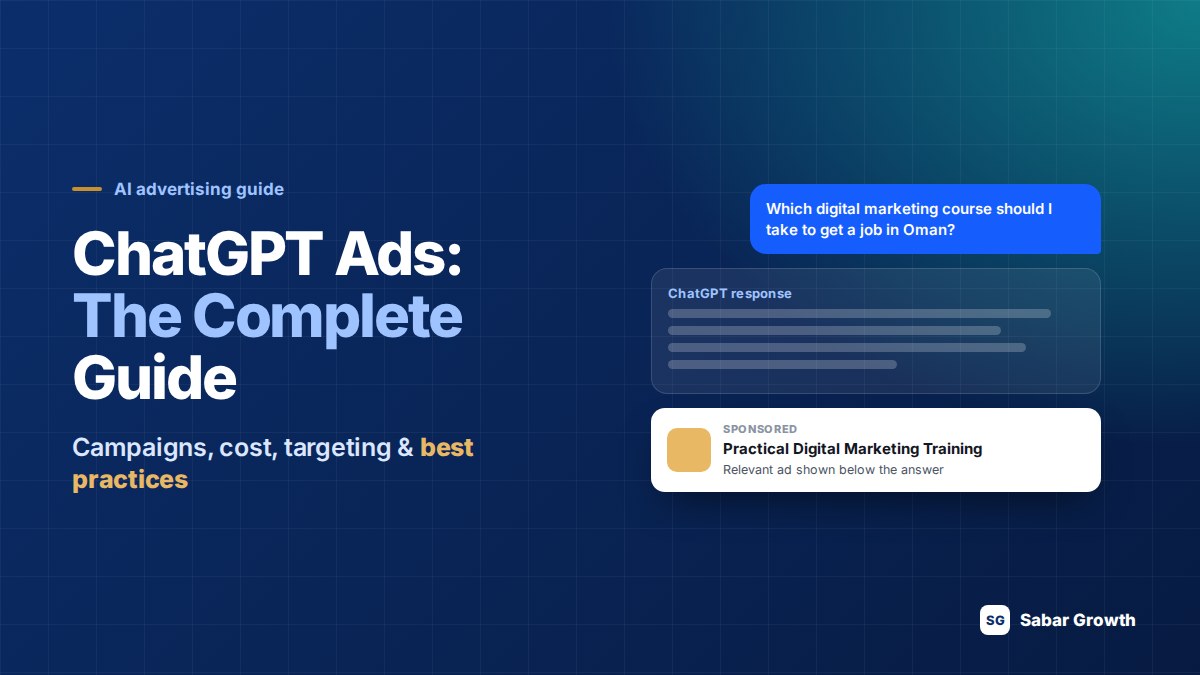

Advertising inside ChatGPT is one of the newest additions to a digital marketer’s toolkit, and it works differently enough from Google Ads and Meta Ads that treating it as “just another ad platform” will lead to wasted budget and confused expectations.
This guide is written as a reference document — something you can bookmark and come back to before you launch your first ChatGPT Ads campaign, whether you’re a student, a freelancer, or a business owner in Oman, the UAE, or elsewhere in the GCC.
Important — Read This First
ChatGPT Ads is a fast-moving beta product. Every figure in this article (pricing guidance, minimum budgets, eligibility rules, policy categories) was checked directly against OpenAI’s official Help Center and Ad Policies pages. Features, pricing, minimum budgets, targeting options, and available markets can change — always verify the current settings shown inside your own Ads Manager account before launching.
What Are ChatGPT Ads, and Why Did OpenAI Introduce Them?
ChatGPT Ads are clearly labelled sponsored placements that appear below certain ChatGPT responses. An ad can include an advertiser name, a favicon or logo, a headline, a short description, an image, and a link to a landing page. OpenAI has been explicit that ads never change or influence what ChatGPT actually says in its answer — the ad sits visually separate, underneath the response.
OpenAI began testing ads with logged-in adult users on the Free and ChatGPT Go tiers in the United States in February 2026, then opened a self-serve Ads Manager to US businesses in May 2026. Through 2026 it progressively expanded self-serve access to more markets, including India, parts of Europe, and the Middle East and North Africa. The stated business logic is straightforward: running ChatGPT at the scale of hundreds of millions of free-tier users is expensive, and advertising gives OpenAI a way to sustain a free, high-quality tier without relying only on subscription revenue.
Who Actually Sees Ads
OpenAI does not show ads to ChatGPT Plus, Pro, Business, Enterprise, or Education subscribers, or to any account identified as belonging to a user under 18. Ads may appear to logged-in adult users on the Free and Go tiers. This is worth knowing before you build a campaign strategy — you are reaching free-tier users specifically, not the entire ChatGPT user base.
How ChatGPT Ads Work
The easiest way to understand ad delivery is as a simple flow from conversation to click:
According to OpenAI’s own documentation, ad selection can consider the context and intent of the current conversation, the ad’s landing page, title and copy, the advertiser’s context hints, and — only when a user has ads personalization enabled — select signals from that user’s broader ChatGPT experience. It’s an auction, specifically a relevance-weighted, second-price auction, meaning the ad most likely to be useful to the user wins, not automatically the highest bidder.
Beginner Tip
Don’t think of context hints as keywords you “bid on.” Think of them as background briefing notes you’re giving OpenAI’s system about your product — who it’s for, what problem it solves, and when someone might need it.
ChatGPT Ads vs Google Ads vs Meta Ads
These are three fundamentally different advertising environments, built around three different user behaviours. A search on Google, a scroll on Instagram, and a conversation with ChatGPT are not the same moment in a customer’s journey.
| Factor | ChatGPT Ads | Google Search Ads | Meta Ads |
|---|---|---|---|
| User behaviour | Actively conversing, researching, comparing | Actively typing a search query | Passively scrolling a feed |
| Intent signal | Conversational context and phrasing | Explicit typed keywords | Interests, demographics, behaviour |
| Targeting basis | Context hints + conversation relevance | Exact/phrase/broad match keywords | Audience segments and lookalikes |
| Keyword targeting | Not exact-match; descriptive hints only | Yes, precise keyword control | No traditional keywords |
| Creative importance | Copy and landing page relevance matter most | Ad copy matters; visuals less so | Visual creative is central |
| Pricing models | CPM, CPC, oCPC (billed per click) | CPC, CPM, tCPA, tROAS | CPM, CPC, various conversion bidding |
| Best use case | Reaching users mid-research, high-consideration decisions | Capturing existing, expressed demand | Building awareness, retargeting, discovery |
| Funnel position | Middle: research and comparison | Bottom: ready-to-act intent | Top/middle: awareness to consideration |
| Example | “I want to learn digital marketing and get a job in Oman. Which skills should I learn?” | “best digital marketing course in Oman” | Scrolling Instagram and matching an audience’s targeting criteria |
None of this means ChatGPT Ads makes Google Ads or Meta Ads obsolete. They answer different questions at different moments. A strong full-funnel strategy can use Meta for awareness, Google for capturing expressed demand, and ChatGPT Ads for reaching people while they’re actively reasoning through a decision in natural language.
Which Businesses Can Benefit From ChatGPT Ads?
Eligibility depends on OpenAI’s Ad Content Policies, not every category is currently allowed, and approvals for some regulated categories are reviewed case by case. Within the categories that are open, these tend to be strong fits:
SaaS & Software
Users often describe a workflow problem in detail before a product is ever named — a natural fit for conversational discovery.
Education & Training
“Which course should I take to become a ___?” is exactly the kind of research conversation ChatGPT Ads is designed to reach.
Professional & Business Services
Consulting, agencies, and B2B services benefit from reaching people mid-comparison rather than mid-scroll.
Travel & Experiences
Trip planning is inherently conversational — itineraries, budgets, and preferences are easy to describe in a chat.
E-commerce
Especially higher-consideration purchases where a shopper compares options in detail before buying.
Household & Consumer Goods
Currently one of OpenAI’s explicitly supported early ad categories alongside local services and digital products.
Financial services, healthcare, and legal services are being rolled out only for approved advertisers on a case-by-case basis, largely in the US, and generally require proof of licensure. Categories such as gambling, alcohol and tobacco, adult content, political advocacy, and recreational drugs are currently disallowed outright. Always check OpenAI’s Ads Policies for your specific category before assuming eligibility.
Can a Business Run ChatGPT Ads With Only a Website?
Yes. A standard, reachable website landing page is enough — you don’t necessarily need an Instagram account, a Facebook page, or a mobile app to advertise. What matters is that OpenAI can actually reach and validate your landing page.
OpenAI uses a dedicated crawler called OAI-AdsBot to visit pages submitted as ad landing pages, check them against its Ad Policies, and read page content to help judge relevance. This is a separate crawler from GPTBot (used for model training data) and OAI-SearchBot (used for ChatGPT’s search feature) — data collected by OAI-AdsBot is not used to train OpenAI’s generative models, and it only ever visits URLs that were explicitly submitted as ad destinations.
Common Technical Blockers
- robots.txt rules that disallow OAI-AdsBot
- Cloudflare, WAF, or bot-mitigation tools blocking the crawler
- CAPTCHA challenges in front of the landing page
- Authentication or login walls
- Geo-blocking that prevents the crawler’s region from loading the page
- Aggressive rate limiting
- Redirect chains the crawler can’t follow cleanly
If your ad isn’t serving, checking these seven items with your developer is one of the first things to do.
Campaign Structure: How ChatGPT Ads Are Organized
Every ChatGPT Ads campaign follows a three-level hierarchy, with context hints and a landing page sitting inside that structure:
At the campaign level, you set the objective (CPM, CPC, or oCPC), a total or daily budget, start and end dates, and country (and, in the US, more granular state/DMA/ZIP) targeting. Inside a campaign, ad groups organize your ads around a specific theme, need, or use case, and carry your context hints. Inside each ad group, individual ads carry the actual creative — title, description, image, and landing page.
Recommended Beginner Structure
- 1 campaign, focused on a single business goal
- 2–3 ad groups, each representing a distinct theme or customer need
- Multiple context hints per ad group, covering natural variations of that need
- 2–3 ad variations per ad group, to test different messaging
- 1 highly relevant landing page per ad group where appropriate, not a generic homepage
Ad groups should stay focused on one product category, theme, or intent area. If two use cases would genuinely need different messaging or a different landing page, OpenAI’s own guidance is to split them into separate ad groups rather than combining unrelated needs into one.
Context Hints: The Most Misunderstood Part of ChatGPT Ads
Context hints sit at the ad group level and describe the conversations, topics, needs, or use cases where your ad may be relevant. OpenAI is explicit on one point: context hints are not exact-match keywords, and they do not guarantee your ad will appear in any specific conversation.
Do This, Not This
Weak: “digital marketing course Oman”
Better — a descriptive set that covers real variations of the need:
- people looking to learn digital marketing from scratch
- people preparing for their first digital marketing job
- people comparing different digital marketing courses
- people wanting practical Google Ads training
- people learning Meta Ads for the first time
- people looking for SEO training with real campaign practice
- people wanting career-focused marketing skills, not just theory
Good context hints add information beyond what your ad title, copy, or landing page already say — they describe what the product offers, who it helps, and when it’s useful, in natural phrases rather than disconnected fragments. Broader conversational coverage within one clear theme tends to give OpenAI’s system more legitimate variations of the same need to match against, without diluting the ad group’s focus.
A Complete Practical Campaign Example
Here’s how the structure above looks in a real scenario for a GCC-based business:
Scenario
Business: Digital Marketing Training Institute | Location: Oman | Objective: Lead generation (oCPC once conversion tracking is live, or CPC while gathering initial data)
Campaign: Digital Marketing Course – Oman – Leads
Ad Group 1 — Digital Marketing Career
- digital marketing career
- digital marketing jobs
- how to become a digital marketer
- skills required for digital marketing jobs
- digital marketing career training
- marketing career change
Ad Group 2 — Digital Marketing Training
- digital marketing course
- learn digital marketing
- practical digital marketing training
- Google Ads training
- Meta Ads training
- SEO training
Sample ad creative:
- Headline: “Learn Digital Marketing the Practical Way” — Description: “Hands-on Google Ads, Meta Ads and SEO training built for real jobs in Oman.”
- Headline: “From Beginner to Job-Ready in Digital Marketing” — Description: “Career-focused training covering the skills employers actually ask for.”
- Headline: “Build a Digital Marketing Career in Oman” — Description: “Practical courses in SEO, Google Ads and Meta Ads, taught by working practitioners.”
Landing page: a dedicated course page (not the homepage), with a clear syllabus, price, and outcomes. Conversion: a lead form, WhatsApp click, or booking action.
The logic here is simple: each ad group represents one clearly defined need (career switching vs. skills training), each has its own tightly themed context hints, and each points to a landing page that matches the specific intent — not a generic “About Us” page.
How Much Does ChatGPT Ads Cost?
There are three pricing models, all set as a maximum bid at the ad group level:
- CPM (Reach): you pay per 1,000 impressions — best for visibility and awareness.
- CPC (Clicks): you pay per valid click — best for driving traffic to your site or product.
- oCPC (Conversions): billing is still per valid click, but the system optimizes delivery toward a specific conversion event you’ve configured. oCPC does not mean you pay per completed conversion — you’re still charged per click.
For CPC campaigns, OpenAI’s official recommendation is to start with a maximum bid of roughly $3–$5 USD per click. This is a starting-point suggestion for competitiveness in the auction, not a universal minimum campaign budget.
| Billing Currency | Minimum Daily Budget |
|---|---|
| AED | 70 AED |
| USD | 25 USD |
| EUR | 15 EUR |
| GBP | 15 GBP |
| INR | 725 INR |
| QAR | 70 QAR |
These minimums vary by billing currency and can change, so confirm the exact amount shown inside Ads Manager before launching. A daily budget is an average delivery amount over a seven-day period — actual daily spend can run higher or lower than your set amount on any single day, though OpenAI caps spend at up to twice your daily budget on an individual day and up to seven times your daily budget across the seven-day window.
How to Measure ChatGPT Ads
Ads Manager reporting currently includes impressions, clicks, spend, click-through rate (CTR), average CPC, average CPM, and conversions.
For basic traffic attribution, advertisers can add static UTM parameters to their landing page URLs, for example:
Example UTM
?utm_source=chatgpt&utm_medium=paid&utm_campaign=digital_marketing_oman
For proper conversion tracking, OpenAI supports a JavaScript Pixel and a server-side Conversions API. Conversion tracking is a requirement before you can run oCPC campaigns — you need at least one supported standard conversion event configured, since oCPC optimizes delivery toward that event even though billing stays per click. Enabling automatic advanced matching on your pixel can also improve how well conversions get matched back to your ads.
Landing Page Best Practices
- Directly relevant to the specific ad, not a generic page
- Fast-loading and mobile-friendly
- Clear headline and a strong value proposition above the fold
- One obvious call to action
- Visible trust signals (reviews, credentials, past work)
- An easy lead form, or a WhatsApp/call option where appropriate
- Accurate information with no misleading claims
- Crawlable by OAI-AdsBot — no login wall, CAPTCHA, or blocking robots.txt rule
Sending every click to your homepage is almost always weaker than sending it to the specific service, course, or product page that matches what the ad promised. A homepage forces the user to re-find what they were already interested in.
Advantages of ChatGPT Ads
Conversational Intent
Reaches people while they describe their actual need in full sentences, not fragments.
Context-Based Relevance
Matching goes beyond literal keywords to the meaning behind a conversation.
Mid-Research Reach
Meets users while they’re actively comparing options, not just after a decision is made.
A Genuinely New Channel
Less competitive today than mature platforms, while OpenAI’s ad ecosystem is still maturing.
Complements Google & Meta
Fits alongside existing channels rather than needing to replace them.
Flexible Optimization
CPM, CPC, and oCPC objectives support different goals from a single platform.
To be clear: there is no evidence that ChatGPT Ads “always converts better” than Google or Meta. Results depend heavily on category, creative quality, and context hint accuracy — treat early performance as a learning phase, not a guarantee.
Current Limitations of ChatGPT Ads
Be Realistic About These
- The platform is still an evolving beta, not a fully mature ad system
- Self-serve availability varies by country and is still expanding
- Not every ChatGPT user sees ads — Plus, Pro, Business, Enterprise, and Education subscribers are ad-free
- Accounts identified as belonging to users under 18 are never shown ads
- Context hints are not exact-match keywords and never guarantee placement
- Advertisers cannot guarantee delivery in any specific conversation
- Targeting is far less granular than Google’s keyword system or Meta’s audience tools
- oCPC requires conversion tracking and a supported standard conversion event — custom events aren’t currently supported for oCPC
- Landing pages must be crawlable and policy-compliant, or ads may fail review
- All ads go through review, and product/service eligibility depends on OpenAI’s Ad Content Policies, with several categories still restricted or disallowed
ChatGPT Ads vs Google Ads: Which One Should a Student Learn?
Don’t treat this as a competition with one winner.
- Learn Google Ads if you want to work with explicit search intent, keyword-based acquisition, high purchase intent, local search, and direct demand capture.
- Learn Meta Ads if you’re drawn to social discovery, audience targeting, visual creative, awareness building, and retargeting funnels.
- Learn ChatGPT Ads if you want early exposure to conversational discovery, AI-assisted research behaviour, contextual intent, and the emerging AI advertising ecosystem.
A strong digital marketer in 2026 understands all three environments well enough to know which one fits a given business goal — not to treat any single one as a replacement for the others.
Step-by-Step: Creating Your First ChatGPT Ads Campaign
Register at Ads Manager
Sign up at ads.openai.com and check current availability for your billing country.
Set up billing
Add advertiser and payment information; confirm your account’s billing currency (this determines your minimum daily budget).
Create your campaign
Give it a clear, descriptive name tied to a single business goal.
Select an objective
Choose CPM (Reach), CPC (Clicks), or oCPC (Conversions).
Set your budget
Choose a campaign-total budget or a daily budget, respecting the minimum for your currency.
Select countries or locations
Use the location picker to confirm what’s currently supported for your market.
Select platforms (optional)
Target iOS App, Android App, or Web where relevant.
Build focused ad groups
One clear theme or customer need per ad group.
Write context hints
Describe real variations of the need in natural phrases, not disconnected keywords.
Create multiple ads
Write 2–3 creative variations per ad group to test messaging.
Choose a relevant landing page
Point each ad group at the page that matches its specific intent.
Configure conversion tracking
Set up the JavaScript Pixel and/or Conversions API before running oCPC.
Review policy compliance
Check your category and creative against OpenAI’s Ad Policies before submitting.
Submit and launch
Ads go through review before they’re eligible to serve.
Monitor results
Give the campaign real time — at least two to three weeks — before major changes.
Optimize
Adjust bids, context hints, and creative based on actual delivery and conversion data.
10 Common ChatGPT Ads Mistakes
| # | Mistake |
|---|---|
| 1 | Treating context hints like exact-match keywords |
| 2 | Running only one ad per ad group, with no variations to test |
| 3 | Sending every click to an irrelevant homepage |
| 4 | Using a slow, unclear, or poorly structured landing page |
| 5 | Launching an oCPC campaign with no conversion tracking configured |
| 6 | Making ad group themes too broad or mixing unrelated products |
| 7 | Writing generic, non-specific ad copy |
| 8 | Making unsupported or exaggerated claims in creative |
| 9 | Accidentally blocking OAI-AdsBot via robots.txt or a firewall |
| 10 | Judging performance too early, before two to three weeks of real data |
The Success Framework
What a Strong ChatGPT Ads Campaign Looks Like
Relevance + a clear offer + strong context hints + multiple creative variations + a relevant landing page + proper tracking + continuous optimization = a strong ChatGPT Ads campaign.
- Relevance: your ad genuinely matches the conversations you’re targeting
- Clear offer: the value proposition is obvious in one glance
- Strong context hints: natural, varied phrases describing real customer needs
- Multiple creative variations: so you learn what messaging actually works
- Relevant landing page: matched to the specific ad group’s intent
- Tracking: UTM parameters plus pixel or Conversions API, set up before launch
- Continuous optimization: reviewing real data before making changes, not guessing
Frequently Asked Questions
ChatGPT Ads are clearly labelled sponsored placements that appear below certain ChatGPT responses. Each ad can include an advertiser name, logo, headline, description, image, and a link to a landing page. They are selected based on the relevance of the current conversation, never by changing what ChatGPT actually says.
Ads appear directly below a ChatGPT response, in a visually separate, clearly labelled sponsored unit. They do not appear inside the AI-generated answer itself, and OpenAI states that ads never influence what ChatGPT tells a user.
No. Google Search Ads target explicit typed keywords with clear purchase intent, while ChatGPT Ads use advertiser-provided context hints combined with the current conversation’s intent. ChatGPT Ads currently offer far less granular targeting than Google Ads and are not a replacement for keyword-based search advertising.
No. ChatGPT Ads do not require a social media presence. A standard, reachable website landing page is enough, provided it is crawlable by OpenAI’s OAI-AdsBot and complies with OpenAI’s Ads Policies.
Yes. A valid, reachable website landing page is the core requirement. The page must not block OAI-AdsBot through robots.txt, a firewall, CAPTCHA, login wall, or similar barrier, or the ad may fail review.
There is no fixed price; cost depends on a relevance-weighted auction. OpenAI recommends starting with a maximum CPC bid of about $3 to $5 USD per click. Minimum daily budgets vary by billing currency, for example USD 25, AED 70, EUR 15, GBP 15, INR 725, and QAR 70.
Both. Advertisers can choose a CPM (Reach) objective priced per 1,000 impressions, a CPC (Clicks) objective priced per valid click, or an oCPC (Conversions) objective, which is also billed per valid click while optimizing delivery toward a chosen conversion event.
oCPC stands for conversion-optimized cost-per-click. It requires conversion tracking to be set up and a supported standard conversion event selected. Importantly, oCPC campaigns are still billed per valid click, not per completed conversion.
Context hints are short, plain-language phrases set at the ad group level that describe the conversations, topics, needs, or use cases where an ad may be relevant. OpenAI is explicit that they are not exact-match keywords and do not guarantee an ad will appear for any specific word, topic, or conversation.
The minimum daily budget depends on the ad account’s billing currency. Documented examples include USD 25, AED 70, EUR 15, GBP 15, INR 725, and QAR 70. Advertisers should always confirm the current amount inside Ads Manager before launching, since minimums can change.
No. ChatGPT Ads reach users during active, conversational research rather than typed search queries or passive social scrolling. Most marketers should treat it as an additional channel in a full-funnel strategy alongside Google Ads and Meta Ads, not a replacement for either.
Sources & Official References
- Ads in ChatGPT — OpenAI Help Center
- Ads in ChatGPT: The Basics — OpenAI Help Center
- Create Campaigns for ChatGPT Ads — OpenAI Help Center
- Create Ad Groups for ChatGPT Ads — OpenAI Help Center
- Conversion-optimized (oCPC) Campaigns — OpenAI Help Center
- Daily Budgets — OpenAI Help Center
- Advertiser Guidance for Allowing OpenAI Web Crawlers (OAI-AdsBot) — OpenAI Help Center
- Ad Policies — OpenAI
- New Ways to Buy ChatGPT Ads — OpenAI
- Expanding Access to AI With ChatGPT Ads — OpenAI
Disclaimer
ChatGPT Ads is an evolving advertising platform. Features, availability, pricing, minimum budgets, targeting options, and policies may change. Always verify the latest settings available in your own Ads Manager account before launching a campaign.
Want to Build Skills Beyond Traditional Ad Platforms?
ChatGPT Ads is one more channel in a much bigger digital marketing skillset. If you’re building toward a real career or a real business result, practical, experience-based guidance beats generic advice every time.
Sabar
Founder, Sabar Growth — Google Ads & Meta Ads
Founder of Sabar Growth, a founder-led performance marketing agency based in Muscat, Oman, working with businesses across Dubai, UAE, Saudi Arabia, Qatar and the GCC. Years of hands-on experience managing Google Ads and Meta Ads campaigns, tracking emerging channels like ChatGPT Ads, and building teams across multiple digital marketing disciplines.
45,000+ qualified leads
141× best blended ROAS