
Google Ads Campaign Structure 2026: Exact, Phrase & Broad Match Explained
A simple, practical breakdown of how to structure a Google Search Ads campaign in 2026 — how to combine Exact, Phrase and Broad Match correctly, and why the campaign you build around them matters more than any single setting.

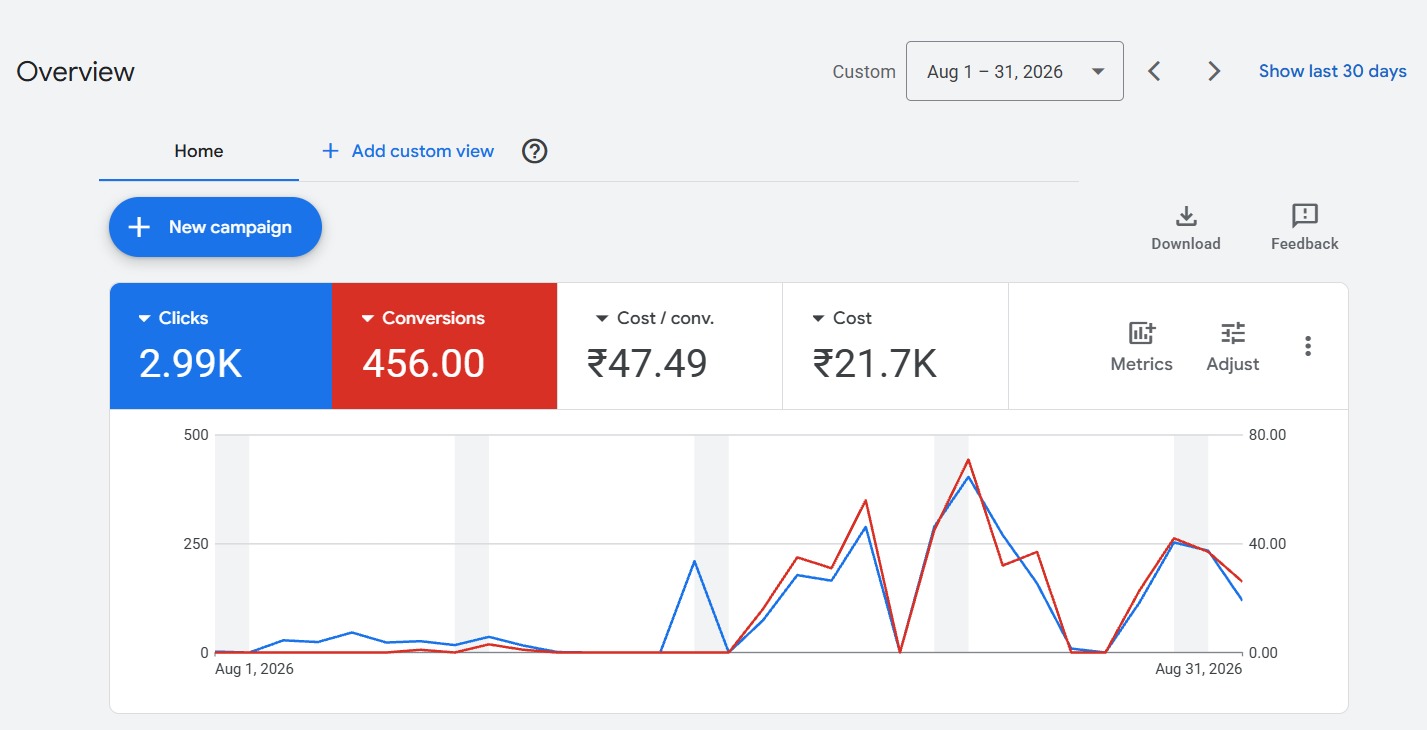
One of our Google Ads campaigns generated 456 conversions for a client. That number is real, but it’s not the point of this article — and it didn’t happen on day one.
It happened after weeks of testing: trying different keyword match types, reviewing what people actually typed into Google before clicking, rewriting ads, cutting what didn’t work, and rebuilding the campaign around a structure that fit the business. That process — not a secret setting — is what this article is really about.
Important
There is no single “correct” Google Ads structure that works for every business. The right structure depends on your budget, your conversion volume, your industry, and how mature your account already is. This article explains a structure that works well for many businesses in 2026 and — just as importantly — when it doesn’t fit.
Why Campaign Structure Matters More Than You’d Think
It’s tempting to think of Google Ads as: pick some keywords, write an ad, set a budget, done. In practice, how you organize those keywords — which ones sit together, which ones are kept separate, and how much freedom you give Google’s automated bidding — has a bigger effect on your results than almost any individual setting.
Two accounts can target the exact same keywords and get very different results, purely because of how the campaign around those keywords was built.
A Quick 2026 Refresher on Match Types
Match types control how closely someone’s search has to resemble your keyword before your ad is allowed to show. All three have changed meaningfully in the last few years, and none of them work quite the way their names suggest anymore.
| Match Type | How It Behaves in 2026 | Best For |
|---|---|---|
| Exact Match | Tightest option, but no longer literal — includes misspellings, plurals, reordered words, and clearly equivalent phrasing. | Your proven, highest-intent keywords |
| Phrase Match | Has absorbed much of what “modified broad match” used to do — casts a noticeably wider net than most people expect. | Natural variations around a core term |
| Broad Match | Fully semantic — matches based on meaning, landing page content, and context, not literal wording. Only works well with automated bidding. | Finding new, relevant searches you haven’t thought of |
Beginner Tip
Don’t think of “exact match” as meaning exact anymore. If you search “trainer for marathon” and a business targets [running shoes for marathon training], that could still match. Match types are about intent now, not spelling.
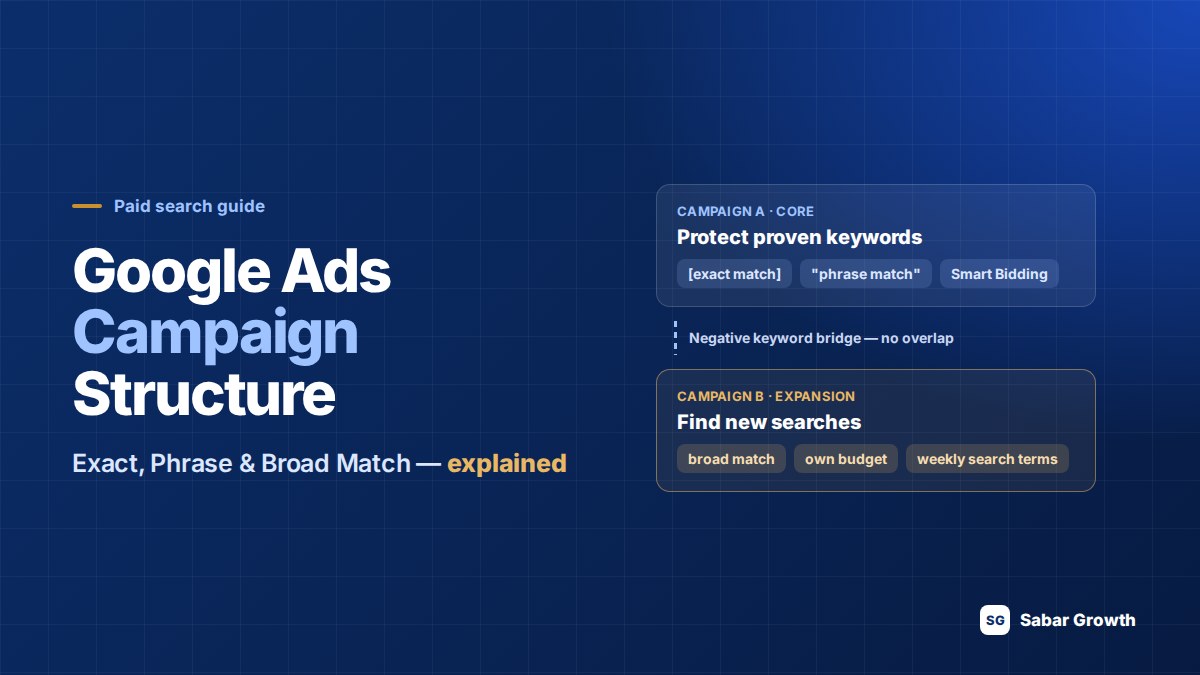
The Core Idea: Two Jobs, Two Campaigns
Here’s the mistake most Google Ads structures make: they ask one campaign to do two very different jobs at once — protect your proven, reliable keywords and go exploring for new ones. Those jobs pull in opposite directions, and when they share the same budget and the same bidding target, the exploring job usually wins, quietly eating into the budget that was supposed to protect your best-performing keywords.
The fix is simple: give each job its own campaign.
The two campaigns aren’t independent, though — they’re connected by one important habit, which we’ll get to shortly: negative keywords.
Campaign A: The Exact + Phrase “Core”
This is your dependable, predictable engine — the keywords you already know convert.
- Ad groups should be built around a theme, not a single keyword. Group 5–15 closely related Exact and Phrase Match keywords together, rather than one keyword per ad group. This is often called a “Single Theme Ad Group” or STAG — the old “one keyword, one ad group” (SKAG) approach is largely outdated now, because it spreads your conversion data too thin for Google’s automated bidding to learn efficiently.
- Don’t duplicate the same keyword as both Exact and Phrase in one ad group — it’s redundant and makes it harder to tell which version is actually driving results. Let Phrase catch natural variations, and use Exact for the terms you already know convert well.
- Bidding: once you have roughly 30+ conversions, Smart Bidding (Maximize Conversions or Target CPA) usually outperforms manual bidding. Below that, Manual or Enhanced CPC gives you more control while you build up data.
Example (Hypothetical)
Business: A home cleaning service in Dubai. Ad Group: “Deep Cleaning” might contain: [deep cleaning service Dubai] (Exact), “deep home cleaning Dubai” (Phrase), [apartment deep clean] (Exact), “deep cleaning company near me” (Phrase) — all one clear theme, no duplicated terms.
Campaign B: The Broad Match “Expansion”
This campaign has one job: find genuinely new, relevant searches that your Core campaign isn’t catching yet. It needs more support than Campaign A, not less.
- Its own budget — separate from Campaign A, so it can’t quietly absorb spend meant for your proven keywords.
- Smart Bidding only. Google’s own guidance is direct about this: Broad Match paired with manual bidding tends to waste spend, because manual bidding can’t evaluate the real-time context Google uses to judge each individual search.
- Enough conversion data to work with. Broad Match generally needs a solid flow of conversions — often cited around 30–50 per month — before Smart Bidding has enough signal to perform reliably. Below that, it can sit in an unstable “learning” state indefinitely.
- Weekly search term reviews. Because Broad Match casts the widest net of the three match types, this is non-negotiable, not optional housekeeping.
Important — Don’t Skip This
Never turn on Broad Match with manual bidding “just to test it carefully.” Google’s own documentation recommends against this combination — Broad Match is built to work with Smart Bidding’s auction-time decisions, not manual bid caps.
The Negative Keyword Bridge: What Connects the Two Campaigns
This is the step that makes the two-campaign structure actually work, and it’s the part most advertisers skip.
Take your best-performing Exact and Phrase Match keywords from Campaign A, and add them as negative keywords inside Campaign B. This stops your Broad Match campaign from re-winning auctions that your Core campaign already wins more efficiently — instead, Broad Match’s budget goes entirely toward genuinely new search territory you haven’t captured yet.
The “Harvesting” Habit
When a search term inside your Broad Match campaign converts consistently, don’t just leave it there. Add it as a new Exact or Phrase keyword inside Campaign A, then add it as a negative inside Campaign B. Over time, your reliable Core campaign keeps growing, and your Broad Match campaign keeps exploring further out — instead of the two overlapping and competing with each other.
What If Your Budget Is Small?
If you’re just starting out — under roughly $1,500–2,000 a month, or with fewer than 15 conversions a month — running two full campaigns can spread your budget too thin to learn anything useful from either one.
In that case, it’s completely reasonable to start with one campaign, Exact and Phrase Match only, skip Broad Match entirely for now, and focus on building up clean conversion data first. Add Broad Match as its own campaign once you’re consistently generating enough conversions to support it.
Optimizing the Structure Over Time
Review search terms weekly
Match type behavior shifts over time — what you see in the search terms report this week may look different next week.
Add negatives immediately
Cut irrelevant themes as soon as you spot them, especially in the Broad Match campaign.
Harvest strong performers
Promote consistently converting Broad Match search terms into Campaign A, then exclude them from Campaign B.
Give Smart Bidding real time
Wait for roughly 50 conversions or 2–3 full conversion cycles before judging performance or making major changes.
Refresh ad copy regularly
Test new headlines and descriptions in your Responsive Search Ads rather than leaving the same assets running indefinitely.
Layer on AI Max for Search once stable
Once your core structure is working, testing AI Max as an addition on top — not a replacement — can help capture more relevant searches.
Common Mistakes to Avoid
| # | Mistake |
|---|---|
| 1 | Mixing Exact, Phrase, and Broad Match all in one ad group |
| 2 | Running Broad Match on manual bidding |
| 3 | Judging a new campaign’s performance after only a few days |
| 4 | Not protecting proven keywords with a negative keyword list in the Broad Match campaign |
| 5 | Letting search term reviews lapse for weeks at a time |
| 6 | Using one keyword per ad group (SKAGs) across an entire account |
| 7 | Assuming this exact structure fits every business regardless of budget or maturity |
When This Structure Works — and When It Doesn’t
Works Well For
Established accounts with 30+ conversions a month, businesses with real room to find more demand, and margins healthy enough to absorb Broad Match’s slower learning period.
Not Ideal For
Brand-new accounts with no conversion history yet, very tight budgets, and highly regulated industries like legal, medical, or financial services where lead quality tolerance is very low.
Good Fit
Lead generation, e-commerce, and service businesses with a genuinely larger addressable market than what their current keyword list already captures.
Poor Fit
Very small, hyper-local businesses where Broad Match’s wider net mostly returns searches outside your actual service area.
The right structure isn’t the one with the most advanced settings — it’s the one that matches your budget, your conversion data, and how much room your business actually has to grow.
Frequently Asked Questions
There is no single best structure for every business, but a common, well-supported approach is to separate a controlled Exact and Phrase Match core campaign from a Broad Match expansion campaign, connecting them with a shared negative keyword strategy so the two don’t compete against each other.
Yes, different Exact and Phrase Match keywords that share the same theme can sit in one ad group. What is generally not recommended is loading the identical keyword as both Exact and Phrase in the same group, since that creates redundant competition and makes performance harder to read.
In most cases, yes. Broad Match performs best with its own budget and its own Smart Bidding target, separate from tightly controlled Exact and Phrase Match keywords, so it doesn’t draw budget away from proven high-intent terms.
Broad Match generally needs a healthy flow of conversion data, often cited around 30 to 50 conversions per month in the campaign, before Smart Bidding has enough signal to perform reliably. Below that, campaigns often stay stuck in an unstable learning phase.
Mostly no. Since exact match now includes close variants and Smart Bidding relies on pooled conversion data, single keyword ad groups tend to fragment data and slow down optimization. Tightly themed ad groups with several related keywords are the more common modern approach.
Smart Bidding strategies such as Maximize Conversions, Target CPA, or Target ROAS. Manual bidding is not recommended with Broad Match, since it cannot evaluate the contextual signals Google uses at each individual auction.
By adding your core Exact and Phrase Match keywords as negatives inside your Broad Match campaign, you stop Broad Match from re-winning auctions your controlled campaign already wins more efficiently, keeping its budget focused on genuinely new search territory.
No. It suits accounts with enough conversion volume and budget to run two campaigns cleanly. Brand-new accounts, very small budgets, and highly regulated or hyper-local businesses are often better served starting with Exact and Phrase Match only.
A Note on the 456 Conversions
That result came from testing this exact process over time on a real account — not from switching on Broad Match and hoping. Structure, patience, and consistent search term review did the actual work. No structure, including this one, guarantees a specific number of conversions; results depend on your industry, budget, competition, and conversion tracking quality.
Want Help Building the Right Structure for Your Business?
Every account is different — budget, industry, and conversion history all change what the right structure looks like. If you’d rather have it built and tested properly than guess, that’s exactly what we do.
Sabar
Founder, Sabar Growth — Google Ads & Meta Ads
Founder of Sabar Growth, a founder-led performance marketing agency based in Muscat, Oman, working with businesses across Dubai, UAE, Saudi Arabia, Qatar and the GCC. Years of hands-on experience managing and restructuring Google Ads and Meta Ads campaigns for measurable, tested results.
45,000+ qualified leads
141× best blended ROAS