
Digital Marketing Job Titles in 2026: Roles, Responsibilities & Skills You Need
Digital marketing is no longer one job. Here’s exactly what a Digital Marketing Executive, SEO Specialist, Social Media Specialist, Performance Marketing Specialist, Growth Marketing Specialist, and Digital Marketing Manager actually do — so you can choose the right path with confidence.
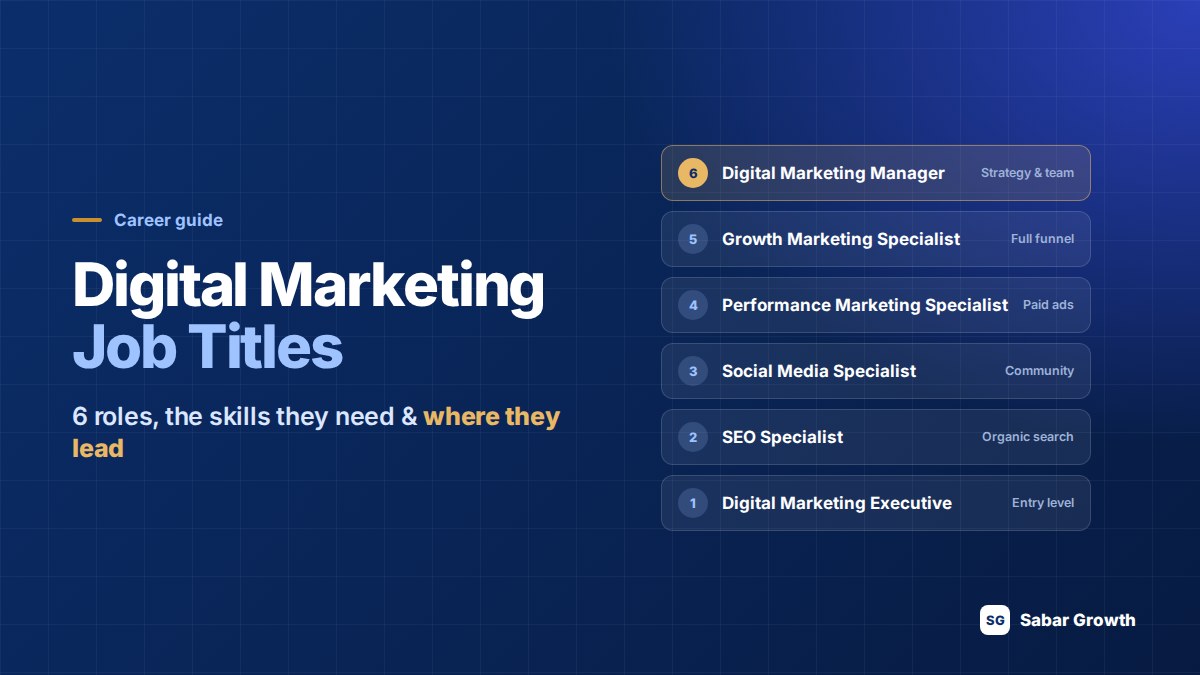

Ten years ago, “digital marketer” was practically one job. In 2026, it’s a whole org chart. A company hiring today might advertise for a Digital Marketing Executive, an SEO Specialist, a Performance Marketing Specialist, a Growth Marketing Specialist, and a Digital Marketing Manager — all in the same week, all technically “digital marketing,” and all doing very different work.
If you’re a student trying to pick a specialization, a fresher applying to your first few roles, or a professional considering a switch, this overlap is genuinely confusing. Job descriptions borrow language from each other, titles vary by company size, and two businesses can use the exact same title for completely different jobs.
This guide breaks down six of the most common digital marketing job titles you’ll encounter in 2026 — what each one actually involves day to day, the tools and skills expected, typical KPIs, and realistic career progression. By the end, you should have a much clearer sense of which direction fits you, or where your current role sits on the bigger map.
Digital Marketing Job Titles Explained
Before getting into each role individually, it helps to understand why the titles diverge in the first place. Digital marketing split into specializations for the same reason medicine split into specialists rather than staying “doctor” — as channels matured (search, paid ads, social, lifecycle marketing), each one became technical enough to need dedicated, deep expertise rather than a generalist doing a bit of everything.
The Quick Version
Generalist roles (Digital Marketing Executive) sit at the entry level. Specialist roles (SEO, Social Media, Performance Marketing, Growth Marketing) sit in the middle, each going deep on one discipline. Management roles (Digital Marketing Manager and above) sit at the top, coordinating specialists and owning strategy and results.
With that framing in place, here’s a detailed look at each of the six roles.
1. Digital Marketing Executive
The Digital Marketing Executive is usually the entry point into a digital marketing career. It’s a generalist role — you’re not expected to be an expert in any single channel yet, but you’re expected to competently support several of them at once.
Job Description
A typical JD for this role covers assisting with social media posting and scheduling, supporting basic paid ad campaigns, helping maintain SEO on-page elements, coordinating with designers or content writers, and compiling performance reports for a manager or client.
Day-to-Day Responsibilities
- Content coordination — scheduling posts, briefing designers, uploading blog content to a CMS
- Basic campaign support — setting up simple Meta or Google Ads campaigns under supervision
- Reporting — pulling numbers from Meta Ads Manager, Google Analytics, or Google Search Console into a weekly or monthly report
- Lead and enquiry tracking — updating spreadsheets or CRM entries, following up on basic queries
- Cross-team coordination — liaising with sales, design, or an external agency on day-to-day requests
Tools & Platforms
Meta Business Suite, Google Ads (basic level), Google Analytics, Google Search Console, Canva, a CMS like WordPress, and spreadsheet tools like Excel or Google Sheets.
Skills
Technical: comfort navigating ad platform dashboards, basic understanding of SEO and paid ads terminology, spreadsheet proficiency.
Soft skills: attention to detail, willingness to learn quickly, clear written communication, and reliability with repetitive coordination tasks.
Typical KPIs
- Content published on schedule
- Engagement rate on social posts
- Basic lead volume from campaigns supported
- Report accuracy and turnaround time
Experience level: 0–2 years. Career progression: Digital Marketing Executive → Specialist (SEO, Social, or Performance Marketing) → Senior Specialist → Manager. Who this suits: fresh graduates, career switchers testing the waters, and anyone who wants broad exposure before choosing a specialization.
2. SEO Specialist
The SEO Specialist owns a business’s visibility in organic (unpaid) search — making sure the right pages show up for the right searches, on Google and increasingly in AI-generated search summaries too.
Job Description
An SEO Specialist JD usually covers keyword research, on-page and technical SEO audits, content optimization, off-page link-building oversight, and monthly ranking and traffic reporting using Google Search Console and Google Analytics.
Core Areas of Work
- On-page SEO — optimizing titles, meta descriptions, headers, internal linking, and content structure for target keywords
- Technical SEO — site speed, mobile-friendliness, crawlability, indexing issues, structured data/schema markup
- Off-page SEO — backlink strategy, outreach, and monitoring for toxic or spammy links that could hurt rankings
- Keyword research — identifying search terms with genuine intent and volume worth targeting
- Content optimization — working with writers to structure content around search intent, not just keywords
- SEO audits — periodic full-site reviews to catch ranking drops, crawl errors, or cannibalization early
Tools
Google Search Console, Google Analytics 4, and one or more paid SEO suites such as Ahrefs or Semrush for keyword research, backlink analysis, and rank tracking.
Skills
Technical: understanding of how search engines crawl and index content, comfort reading Search Console and analytics data, basic familiarity with HTML structure. Analytical: ability to diagnose why a page or site lost rankings using data rather than guesswork. Soft skills: patience (SEO results take months, not days) and clear reporting to stakeholders who expect faster results than the channel delivers.
Typical KPIs
- Organic traffic growth
- Keyword ranking improvements
- Organic leads or conversions
- Domain authority / referring domains
Career progression: SEO Specialist → Senior SEO Specialist → SEO Lead / Head of SEO → SEO Consultant or Agency Owner. Who this suits: people who enjoy research, patterns, and data more than fast-paced daily changes, and who like the idea of compounding results over time.
3. Social Media Specialist
The Social Media Specialist owns a brand’s presence and community across platforms — building an audience organically, rather than through paid distribution alone.
Job Description
This role typically covers social media strategy, content calendar planning, platform-specific execution across Instagram, Facebook, LinkedIn, TikTok, and YouTube, community management, and reporting on organic growth and engagement.
Core Areas of Work
- Strategy and planning — deciding what content themes and formats fit each platform and audience
- Content calendars — mapping out weeks or months of content in advance, coordinated with campaigns and launches
- Platform management — publishing, scheduling, and adapting content per platform (Reels vs LinkedIn posts vs YouTube Shorts)
- Community management — replying to comments and DMs, moderating discussion, protecting brand tone
- Collaboration — briefing designers, videographers, or content creators and giving feedback on drafts
- Analytics — tracking reach, engagement, follower growth, and which content formats perform best
Skills & Tools
Creative skills: a strong sense of what stops the scroll on each platform, and comfort giving creative direction even without personally designing every asset. Communication skills: writing captions and community replies in a consistent brand voice. Tools: Meta Business Suite, a scheduling tool such as Later or Buffer, Canva or CapCut, and native platform analytics (Instagram Insights, TikTok Analytics, YouTube Studio).
Typical KPIs
- Follower growth rate
- Engagement rate (likes, comments, shares, saves)
- Reach and impressions
- Organic traffic or leads driven from social
Career progression: Social Media Specialist → Senior Social Media Specialist → Social/Content Lead → Brand or Content Marketing Manager. Who this suits: people who enjoy creativity and communication, understand internet culture and platform trends, and like the feedback loop of watching content perform in real time.
4. Performance Marketing Specialist
This is where digital marketing gets financially accountable. A Performance Marketing Specialist runs paid campaigns — primarily Google Ads and Meta Ads — where every dirham spent is expected to be tracked back to a measurable outcome: a lead, a sale, a booking.
“Running Ads” vs Performance Marketing
Anyone can turn on a Meta ad in ten minutes. Performance marketing is what happens after that — setting up proper conversion tracking, structuring campaigns around a clear funnel, testing creative and audiences systematically, and continuously optimizing based on cost-per-result rather than vanity metrics like reach or impressions. The difference shows up in the numbers, not the setup screen.
Job Description
The JD typically covers campaign setup and management across Google Search, Display, YouTube, and Meta Ads, audience targeting, budget allocation and pacing, conversion tracking implementation, landing page optimization, and ongoing performance reporting.
Core Areas of Work
- Campaign setup — structuring campaigns, ad groups, and audiences correctly from the start
- Audience targeting — building and refining audiences based on intent, behavior, and past performance data
- Budget management — allocating spend across campaigns based on what’s actually converting
- Conversion tracking & attribution — setting up pixels, conversion APIs, and understanding which touchpoints deserve credit for a sale
- A/B testing — testing creative, copy, and landing pages against each other with a clear hypothesis
- Landing page optimization — working with design or dev teams to improve conversion rate, not just traffic
Skills & Tools
Analytical: comfortable reading a data table full of CTR, CPC, and ROAS figures and knowing what to change next. Technical: setting up Meta Pixel/Conversions API, Google Tag Manager, and Google Analytics 4 goals correctly. Tools: Google Ads Manager, Meta Ads Manager, Google Tag Manager, GA4, and a reporting layer like Looker Studio.
Typical KPIs
- ROAS (Return on Ad Spend)
- CPA / CPL (Cost per Acquisition / Lead)
- CAC (Customer Acquisition Cost)
- CTR and conversion rate
Career progression: Performance Marketing Specialist → Senior Performance Marketer → Paid Media Lead → Growth Marketing Specialist or Performance Marketing Consultant. Who this suits: people who like data, numbers, and continuous optimization, and who get satisfaction from watching a cost-per-lead number improve week over week.
5. Growth Marketing Specialist
Growth Marketing is the newest of these six titles and the one most often misunderstood. It’s not “performance marketing with a trendier name” — it’s a broader discipline focused on the entire customer lifecycle, not just acquisition.
The Full-Funnel Concept
Growth marketers commonly think in terms of a five-stage framework, often shortened to AARRR: Acquisition, Activation, Retention, Referral, and Revenue. Traditional digital marketing — and performance marketing specifically — mostly lives in the Acquisition stage: getting people to your site or store in the first place. Growth marketing asks the harder follow-up questions: once they arrive, do they actually activate (sign up, make a first purchase)? Do they come back (retention)? Do they tell others (referral)? And is the whole funnel actually profitable (revenue)?
Job Description
The JD usually covers customer acquisition strategy, activation and onboarding optimization, retention and lifecycle campaigns, referral program design, funnel analysis and CRO (conversion rate optimization), and running structured experiments across marketing and product touchpoints.
Core Areas of Work
- Funnel optimization — mapping the full customer journey and finding where the biggest drop-offs happen
- Experimentation — running structured A/B or multivariate tests with clear hypotheses, not random tweaks
- CRM & lifecycle marketing — email and WhatsApp automation sequences that nudge users from signup to repeat customer
- Data analysis — going deeper than campaign dashboards into product and behavioral data (cohorts, retention curves)
- Product/marketing collaboration — working closely with product teams since growth often requires product changes, not just marketing ones
- Automation & AI tools — using automation platforms and AI-assisted analysis to move faster on experiments
Skills
Analytical thinking: comfort with cohort analysis, retention curves, and statistical significance in test results. Strategic thinking: the ability to prioritize which experiments are worth running based on potential impact, not just ease of execution. This role also draws on performance marketing skills as one input among several.
Typical KPIs
- Activation rate
- Retention / churn rate
- Referral rate
- Customer lifetime value (LTV)
Career progression: Growth Marketing Specialist → Senior Growth Marketer → Growth Lead → Head of Growth. Who this suits: people who enjoy business strategy and experimentation more than any single channel, and who want to understand how marketing connects to product and revenue, not just traffic.
6. Digital Marketing Manager
The Digital Marketing Manager is often assumed to be simply “a more experienced executive.” It isn’t. The jump from specialist to manager is a jump from execution to ownership — of strategy, of a team, of a budget, and of results the business actually cares about.
Job Description
The JD typically covers overall digital marketing strategy, managing a team of specialists (or external agencies), budget allocation across channels, performance reporting to leadership, vendor and agency management, and final accountability for lead generation and conversion targets.
Core Areas of Ownership
- Strategy — deciding which channels get investment and why, based on business goals, not personal preference
- Team management — hiring, coaching, and reviewing specialists across SEO, paid media, social, and content
- Budget management — allocating and defending a marketing budget across multiple channels and campaigns
- Agency/vendor management — briefing, reviewing, and holding external partners accountable for results
- Cross-channel oversight — making sure SEO, paid media, social, content, and CRM efforts work together instead of in silos
- Stakeholder management — translating marketing performance into language leadership and sales teams actually care about
Not Just a Senior Executive
A Digital Marketing Manager is judged on business outcomes — revenue, cost per lead across the whole channel mix, team performance — not on how well they personally execute a single campaign. It requires leadership, decision-making under uncertainty, and the judgment to know when a specialist’s recommendation should be trusted versus questioned.
Skills
Leadership: managing and developing a team of specialists with different strengths. Strategic: connecting marketing activity to actual business goals, not just channel-level metrics. Technical understanding: enough working knowledge across SEO, paid media, and analytics to review a specialist’s work critically, without necessarily executing it hands-on anymore.
Typical KPIs
- Overall lead volume and quality
- Blended cost per lead / cost per acquisition
- Marketing-sourced revenue
- Team and agency performance against targets
Career progression: Digital Marketing Manager → Senior Manager → Marketing Lead / Head of Marketing → Director → CMO. Who this suits: specialists who’ve built deep channel expertise and now want broader ownership, business impact, and the responsibility of leading a team.
Comparison: Digital Marketing Job Titles at a Glance
| Job Title | Primary Focus | Experience Level | Core Skills | Main Tools | Key KPIs | Best Suited For |
|---|---|---|---|---|---|---|
| Digital Marketing Executive | Broad support across channels | 0–2 years | Coordination, reporting, adaptability | Meta Suite, GA4, Canva, Sheets | Content delivery, basic leads | Freshers, generalists |
| SEO Specialist | Organic search visibility | 1–4 years | Research, technical SEO, patience | Search Console, GA4, Ahrefs/Semrush | Organic traffic, rankings | Analytical, research-minded people |
| Social Media Specialist | Organic audience & community | 1–4 years | Creativity, brand voice, trend awareness | Meta Suite, scheduling tools, native analytics | Engagement, follower growth | Creative, communication-driven people |
| Performance Marketing Specialist | Paid acquisition & ROI | 1–4 years | Data analysis, testing, tracking | Google Ads, Meta Ads, GTM, GA4 | ROAS, CPA/CPL, CTR | Data-driven, optimization-focused people |
| Growth Marketing Specialist | Full customer lifecycle | 2–5 years | Experimentation, strategic thinking | CRM/automation tools, analytics suites | Activation, retention, LTV | Strategic experimenters |
| Digital Marketing Manager | Strategy, team & budget ownership | 4+ years | Leadership, cross-channel judgment | Reporting dashboards, all of the above (oversight level) | Revenue, blended CPL, team output | Experienced specialists ready to lead |
Which Digital Marketing Career Is Right for You?
There’s no single correct path — but your natural interests are a genuinely useful starting signal:
- If you enjoy data and numbers → Performance Marketing or Marketing Analytics will feel natural, since success is measured constantly and visibly.
- If you enjoy search and research → SEO rewards curiosity, pattern-spotting, and patience with slower feedback loops.
- If you enjoy creativity and communication → Social Media or Content roles let you combine strategy with storytelling.
- If you enjoy business growth and experimentation → Growth Marketing suits people who like connecting marketing to product and revenue.
- If you enjoy strategy and leadership → Digital Marketing Manager is the natural direction once you’ve built real channel expertise.
It’s worth being honest that these categories aren’t rigid boxes. Plenty of strong performance marketers are also decent at SEO. Many growth marketers started in performance marketing and expanded outward. Skills compound and transfer more than job titles suggest — the titles above describe where your primary focus sits, not the limits of what you’re capable of learning.
Skills Every Digital Marketer Should Develop in 2026
Regardless of which specialization you choose, a few capabilities are becoming valuable across every one of these roles:
- AI-assisted workflows — using AI tools to speed up research, first drafts, and campaign analysis, while still applying human judgment to the output
- Marketing automation — understanding how automated sequences (email, WhatsApp, CRM) support acquisition and retention
- First-party data & privacy-conscious tracking — as third-party cookies fade further, comfort with first-party data collection and server-side tracking matters more
- Attribution & analytics literacy — being able to read GA4 and platform data confidently, not just glance at surface-level metrics
- Conversion rate optimization (CRO) — thinking beyond traffic to what actually happens once someone lands on a page
- Experimentation mindset — treating campaigns and content as testable hypotheses rather than one-shot efforts
On AI and Job Security
AI is changing how marketers work — it hasn’t made marketers irrelevant. Tasks like first-draft copy, basic data summarization, and campaign research are faster with AI assistance. But choosing the right strategy, interpreting what the data actually means for a specific business, and building genuine creative or client relationships still need a human. Professionals who combine solid marketing fundamentals with comfort using AI and data tools are becoming more valuable, not less.
Career Progression in Digital Marketing
A common, though not the only, progression looks like this:
Digital Marketing Executive
Broad exposure across channels while learning the fundamentals.
Specialist
Choosing one channel — SEO, Social, or Performance Marketing — and going deep.
Senior Specialist
Owning bigger accounts or budgets and mentoring junior team members.
Manager
Moving from execution to strategy, team leadership, and budget ownership.
Lead / Head of Marketing
Owning marketing outcomes across the full department, not just one channel.
Director / CMO
Shaping company-wide growth and marketing strategy at the leadership level.
This ladder isn’t the only route up, though. Specialists commonly branch off in different directions depending on what they enjoy:
- Specialist → Consultant — working independently across multiple clients rather than one employer
- Specialist → Agency — moving into agency-side work managing several client accounts at once
- Specialist → Freelance — building a personal client base and controlling your own workload
- Specialist → Growth Lead — expanding from one channel into full-funnel growth ownership
- Specialist → Marketing Manager — the traditional route into people and budget management
None of these is a “better” path than the others — they suit different personalities, risk appetites, and long-term goals.
The job title tells you where someone’s focus sits today. It doesn’t tell you where they’ll end up — that’s shaped by curiosity, consistency, and how deliberately they build skills outside their comfort zone.
Final Takeaway
Digital marketing job titles in 2026 aren’t just different labels for the same work — each one represents a genuinely different day-to-day, a different skill set, and a different way of being measured. Understanding these differences isn’t just useful for job hunting; it helps you have clearer conversations with your manager, your team, or the specialists you hire, about what a role actually requires.
If you’re early in your career, don’t feel pressure to pick the “right” specialization immediately — a year or two as a generalist Digital Marketing Executive is a completely normal way to figure out what genuinely interests you before committing to a deeper path.
If you’d like a guided route into one of these roles, I mentor students and working professionals through 1:1 digital marketing training with a real project and interview preparation, in English or Malayalam.
Frequently Asked Questions
The most common titles are Digital Marketing Executive, SEO Specialist, Social Media Specialist, Performance Marketing Specialist, Growth Marketing Specialist, and Digital Marketing Manager. Larger companies may split these further into Paid Media Specialist, Content Strategist, CRM/Lifecycle Marketer, or Marketing Analyst, but these six cover most roles you’ll see advertised in 2026.
A Digital Marketing Executive is typically a generalist handling a bit of everything — social posting, basic ads, reporting — usually early in their career. A Specialist has narrowed into one channel, such as SEO or Performance Marketing, and is expected to have deeper, more technical expertise in that one area rather than broad but shallow knowledge.
Yes. Performance marketing is a specialized branch of digital marketing focused specifically on paid, measurable channels like Google Ads and Meta Ads, where every dirham spent is tracked against a return. It sits alongside SEO, social media, and content as one of the core disciplines under the digital marketing umbrella.
You need hands-on platform skills in Google Ads and Meta Ads Manager, a solid grasp of conversion tracking and attribution, comfort reading data in Google Analytics or a similar tool, and the analytical mindset to test, measure, and optimize campaigns rather than just launch them and hope for the best.
Yes. SEO remains one of the most in-demand digital marketing specializations because organic search still drives a large share of website traffic and leads, and the rise of AI-powered search has actually increased demand for specialists who understand technical SEO, content structure, and how to earn visibility in both traditional and AI-generated search results.
A Growth Marketing Specialist looks at the entire customer journey — acquisition, activation, retention, referral, and revenue — rather than just generating traffic or leads. They run structured experiments across marketing, product, and lifecycle touchpoints to find what actually moves the numbers that matter to the business.
Performance marketing focuses primarily on paid acquisition channels and measurable ad performance. Growth marketing is broader — it includes performance marketing as one lever, but also covers onboarding, retention, referral programs, and product-level experiments, with the goal of improving the full customer lifecycle, not just the top of the funnel.
Start by picking one channel to go deep on — SEO, paid ads, or social media are common entry points — and build hands-on experience through a real account, an internship, or supervised freelance work. Certifications from Google and Meta help, but a portfolio of real campaigns or optimizations you can explain in an interview matters far more than credentials alone.
A typical path moves from Digital Marketing Executive to Specialist, then Senior Specialist, Manager, Lead or Head of Marketing, and eventually Director or CMO. This isn’t the only route — specialists also move into consulting, agency leadership, freelancing, or growth-focused roles depending on their strengths and interests.
Want Help Choosing — or Getting Job-Ready?
If you’re building a career in digital marketing, my 1:1 training and interview preparation at Learn with Sabar is built for exactly that: a real project, practical skills and honest feedback, in English or Malayalam.
Sabar
Founder, Sabar Growth — Google Ads & Meta Ads
Founder of Sabar Growth, a founder-led performance marketing agency based in Muscat, Oman, working with businesses across Dubai, UAE, Saudi Arabia, Qatar and the GCC. Years of hands-on experience managing Google Ads and Meta Ads campaigns, hiring and mentoring marketing specialists, and building teams across multiple digital marketing disciplines.
45,000+ qualified leads
141× best blended ROAS