
The Ecommerce Meta Ads Funnel New Brands Are Missing: WhatsApp Before Website
Sending cold Meta Ads traffic straight to a brand-new website rarely converts the way beginners expect. Here’s the WhatsApp-to-website-to-retargeting funnel that builds trust first — and where it actually fits.
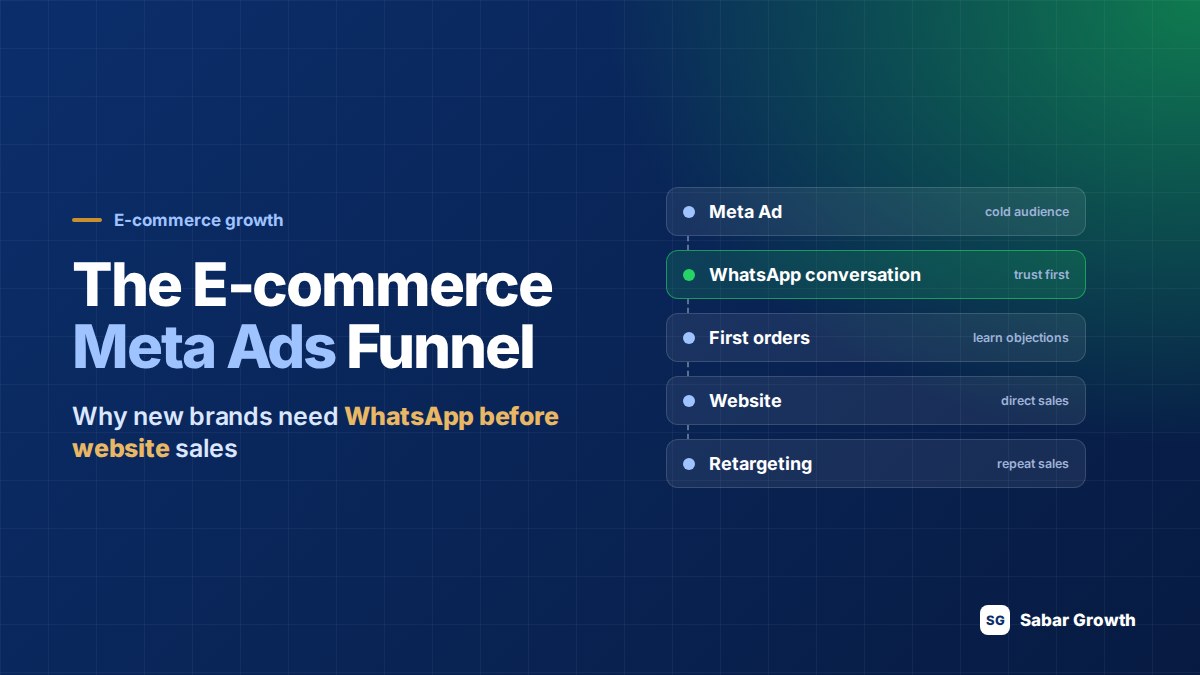

Here’s a mistake I see constantly from new e-commerce brands, Meta Ads beginners, students, and even some agencies: launch a new website, turn on a Meta Sales campaign, send cold traffic straight to the homepage, and expect purchases to follow.
Sometimes it works. Often it doesn’t — and the ad account, the website, and the product all get blamed for a problem that’s really about trust.
When a brand is brand new, people clicking the ad don’t know it yet. They might love the product in the photo and still leave without buying, because somewhere in their head they’re asking questions the website never answered: Is this genuine? Will it actually arrive? What if I don’t like it? This article walks through an ecommerce Meta Ads funnel that treats those questions as the real first step — not an afterthought.
Why Direct Website Sales Can Be Difficult for a New E-commerce Brand
There’s a difference between traffic, interest, trust, and conversion — and a lot of new advertisers treat them as the same thing.
A customer sees your ad on Instagram. They click it. That’s traffic. They scroll your product page a little longer than usual. That’s interest. But before they type in their card details, something else has to happen: they need to believe the brand is real, the product matches the photos, and the order will actually show up. That’s trust. Only once trust exists does interest turn into conversion.
A new website with a new Meta Ads account has plenty of the first two — traffic and interest — but almost none of the third. The ad and the website usually aren’t the problem. The missing step in between is.
Worth Sitting With
“Can I trust this brand?” “Is this product genuine?” “What happens if I don’t like it?” Those questions don’t go away just because someone clicked your ad — and a product page rarely answers all of them on its own.
The Problem With “Meta Ad → Website → Purchase”
To be clear, this isn’t a bad funnel. Meta Ads for e-commerce businesses very often runs exactly this way, and for the right brand, it works well.
It tends to work when the brand already has awareness, strong social proof, visible reviews, existing customers, competitive pricing, a website people already trust, and a product that doesn’t require much convincing to buy. Established stores check most of those boxes. A brand-new one usually checks none of them yet.
| Stage | What It Means | What Moves It Forward |
|---|---|---|
| Traffic | Someone clicked the ad | Relevant targeting, a clear offer |
| Interest | They’re looking, maybe scrolling the product page | Good product presentation |
| Trust | They believe the brand and product are real | Answered questions, proof, a real conversation |
| Conversion | They complete the purchase | Trust plus a low-friction checkout |
So this isn’t an argument against direct website sales campaigns. It’s that a new brand may need an extra stage or two before “website → purchase” starts converting the way it should.
A Better Funnel: Meta Ads → WhatsApp → Trust → Website → Retargeting
The alternative isn’t to abandon the website. It’s to give cold traffic somewhere lower-pressure to land first — a conversation instead of a checkout page — so trust has a chance to build before you ask for the sale.
The purpose here isn’t to say every e-commerce brand must sell through WhatsApp, or that websites are unnecessary. It’s that WhatsApp can work as a conversation and trust-building layer while a new brand is still earning credibility, with more customers gradually moving toward direct website purchases as that credibility builds.
Stage by Stage
Cold Audience
Meta Ads reach new potential customers who have never heard of the brand before.
WhatsApp Conversation
Instead of pushing every cold click straight to checkout, interested users start a conversation — a much smaller commitment than a purchase.
Trust Building
The business answers real questions about the product, price, delivery, returns, warranty, and anything else standing in the way.
First Orders
Early on, the business owner or a small team handles enquiries manually and learns what customers actually ask, before automating anything. Somewhere in the first 50–100 orders — depending on the business — is usually enough to see the patterns.
Website
Once customers understand and trust the brand better, the website becomes a stronger direct-purchase channel — especially once it’s been refined using what was learned on WhatsApp.
Retargeting
Website visitors, engaged users, and previous customers become the eligible warm and hot audiences for follow-up campaigns and repeat sales.
Why WhatsApp Can Improve the Customer Journey
Think of WhatsApp as a conversation, trust, and conversion layer — not a replacement for the website. Its real value isn’t that it closes sales (though it often does); it’s that it surfaces the exact objections a cold visitor never says out loud on your website.
Sample WhatsApp Conversation
Customer: Is this available in blue?
Business: Yes, it’s in stock — here’s a photo and the price.
Customer: How long does delivery take?
Business: 2–4 working days, and we’ll send tracking once it ships.
Customer: What if I want to return it?
Business: You have 7 days to return it unused — here’s how that works.
Every one of those answers is information your website probably isn’t giving upfront. That’s the real insight: these conversations are a live list of the objections stopping people from buying — and once you have that list, you can go fix the actual gaps in your e-commerce customer journey. Feed what you learn back into your product page, your FAQs, your ad creative, your offers, your landing pages, and even your retargeting messages. Few things improve conversion rate as directly as knowing, in the customers’ own words, why they hesitate.
How WhatsApp Automation Fits Into the Funnel
Once enquiry volume grows, you don’t need to manually type the same delivery-time answer fifty times a day. That’s where automation earns its place — after you already know what customers ask, not before.
A Typical Automated Flow
Ad → WhatsApp → Welcome message → Product selection → Price → Delivery info → FAQ → Product details → Lead qualification → Human handover → Purchase.
Tools like WATI, Respond.io, and AiSensy can all run a flow like this. This isn’t a tool comparison, and none of them is universally “the best” — the right one depends on your business size, the integrations you need, how much automation you actually want, your team size, whether you need CRM syncing, and your budget. Pick based on your situation, not a ranking list.
When You Should Start Pushing More Sales Through Your Website
Once you understand the recurring questions, objections, best-selling products, price sensitivity, delivery concerns, and general buying behavior of your audience, it’s time to push harder toward the classic Product Page → Add to Cart → Checkout → Purchase path — now backed by real customer data instead of guesses.
By this point, your website should carry its own weight on trust. That means:
- Reviews and testimonials that are visible, not buried.
- Clear product information — no vague descriptions.
- Delivery details stated upfront, not hidden in a policy page.
- Return and refund policy that’s easy to find.
- Visible contact information, so the brand feels reachable.
- Secure payment signals and recognizable payment options.
- FAQs built from what WhatsApp already taught you.
- Social proof — real photos, real customers, real numbers where you have them.
Building Retargeting Audiences
Meta Ads retargeting re-engages people who’ve already shown some level of interest, based on the signals and audience configurations available to your ad account. In practice that usually looks like:
- Website visitor → a retargeting ad reminding them what they viewed.
- Instagram or Facebook engagement → a retargeting audience built from people who interacted with your content or ads.
- Previous customer → a repeat-purchase campaign.
- Product page interaction → a follow-up offer relevant to what they looked at.
Getting This Right
The Pixel and Conversions API are measurement and event-sharing mechanisms — they send signals like page views or purchases back to Meta. They are not, on their own, a retargeting audience; the audience is built from the signals they provide. And to be clear on scope: Meta doesn’t see what you searched on Google, doesn’t hand your Pixel data to other advertisers, and visiting a competitor’s site doesn’t give anyone access to that competitor’s visitor list. Retargeting works from first-party signals a business has explicitly set up, within Meta’s own audience tools and privacy controls — not from tracking everything everywhere.
Cold vs. Warm vs. Hot Audiences
Not every audience deserves the same message. Knowing where someone sits in your e-commerce sales funnel changes what you should say to them.
| Audience | Who They Are | What Works Best |
|---|---|---|
| Cold | Haven’t interacted with the brand yet | Broad or interest-based prospecting |
| Warm | Engaged with an ad, content, or WhatsApp, but haven’t purchased | Retargeting that answers objections directly |
| Hot | Viewed products, added to cart, or purchased before | Direct offers, repeat-purchase campaigns |
A Practical Example
Picture a new skincare brand launching its first website. Instead of relying only on Meta Ad → Website → Purchase, they test Meta Ad → WhatsApp first.
The questions come in fast: Is this suitable for oily skin? How long does delivery take? Is cash on delivery available? What’s the return policy? How should I actually use this?
None of that is surprising once you see it written down — but it’s exactly the information a cold visitor won’t type into a contact form. The brand uses it to rework the product page, tighten the FAQs, adjust the ad copy and creative, sharpen the offer, and add the trust signals that were missing. Only then do they run a full Meta Sales Campaign straight to the website, retargeting the warm audiences that WhatsApp and the website visits already built.
Common Mistakes
- Sending all cold traffic straight to checkout with no lower-commitment step in between.
- Expecting immediate purchases from a brand nobody’s heard of.
- Ignoring customer questions instead of treating them as free market research.
- Not collecting objections anywhere they can actually be used later.
- Running a weak product page that doesn’t answer basic hesitations.
- Launching ads without proper tracking in place first.
- Never building warm audiences to retarget in the first place.
- Retargeting without a clear offer or message — just showing the same ad again.
- Automating WhatsApp before understanding real customer questions.
- Treating traffic and conversion as the same thing, when they’re several steps apart.
When Direct Website Sales Make Sense
This Isn’t “WhatsApp Always Wins”
A direct Meta Ad → Website → Purchase funnel can work very well when:
- Brand awareness is already strong
- Product-market fit is established
- The website carries strong trust signals
- Customer reviews are visible and genuine
- The price point is low to moderate
- The product is easy to understand at a glance
- You already have existing customer data to work from
- Tracking and conversion signals are solid
Recommended Funnel Framework
Put together, the full path looks like this: Cold Audience → Meta Ads → WhatsApp → Trust → First Orders → Website → Retargeting → Repeat Sales. Not every business needs all six stages forever — but a new brand skipping straight from “cold audience” to “purchase” is usually skipping the stages that would have made the ad spend work harder.
On campaign objectives: match the setup to the funnel stage and the business outcome you actually want — sales, engagement, traffic, or a messaging/leads-focused approach where that fits. Meta’s available objectives and features change over time, so build around whatever your Ads Manager currently offers rather than a fixed rule. The real principle doesn’t change: choose the setup based on the outcome you want and the conversion signals you actually have.
Final Takeaway
None of this means WhatsApp is mandatory or that websites don’t matter. It means a new e-commerce brand’s WhatsApp sales funnel and website can work together — one building the trust, the other closing the sale once that trust exists.
The next step usually isn’t a bigger ad budget. It’s fixing the customer journey in between.
Frequently Asked Questions
No. It’s most useful for new or lesser-known brands where cold traffic still has unanswered trust questions. Established brands with strong reviews, awareness, and low-hesitation products often convert well going straight to the website.
There’s no fixed number. Somewhere in the first 50–100 orders is often enough to see the repeating questions and objections, but this depends entirely on your product, price point, and enquiry volume.
The Pixel (and Conversions API) are measurement and event-sharing mechanisms — they send signals like page views or purchases back to Meta. Retargeting audiences are built from those signals, but the Pixel itself is not the audience; it’s the data pipeline that makes building one possible.
No. Meta’s advertising systems work from signals tied to Meta’s own platforms and any measurement tools — like the Pixel or Conversions API — that a business has explicitly installed on its own site, not from your Google search history or browsing on unrelated sites.
Usually not. It’s more useful to handle early enquiries manually first, learn the real questions customers ask, and then automate the repetitive parts once volume justifies it. Automating too early risks encoding guesses instead of real customer behavior.
Cold audiences haven’t interacted with your brand yet. Warm audiences have engaged with your ads, content, or WhatsApp but haven’t purchased. Hot audiences have shown stronger intent — product page visits, cart activity, or a previous purchase — and are usually the strongest group to retarget.
When brand awareness and product-market fit are already established, the website has strong trust signals like reviews and clear policies, the product has low purchase hesitation, and conversion tracking is already reliable.
Are You Sending Every Meta Ads Visitor Straight to Your Website?
Your next step may not be increasing your ad budget. It may be fixing the customer journey in between. See how this kind of funnel has worked for real e-commerce clients first.
Sabar
Founder, Sabar Growth — Google Ads & Meta Ads
Founder of Sabar Growth, a founder-led performance marketing agency based in Muscat, Oman, working with businesses across Dubai, UAE, Saudi Arabia, Qatar and the GCC. Years of hands-on experience managing Google Ads and Meta Ads campaigns with direct accountability for qualified leads, cost per lead, and revenue.
45,000+ qualified leads
141× best blended ROAS