
The Meta Ads Campaign Structure That Actually Works in 2026
Stop building ten fragmented ad sets. Here’s the campaign structure that gives Meta’s algorithm the room and the signals it needs to find your actual customers.
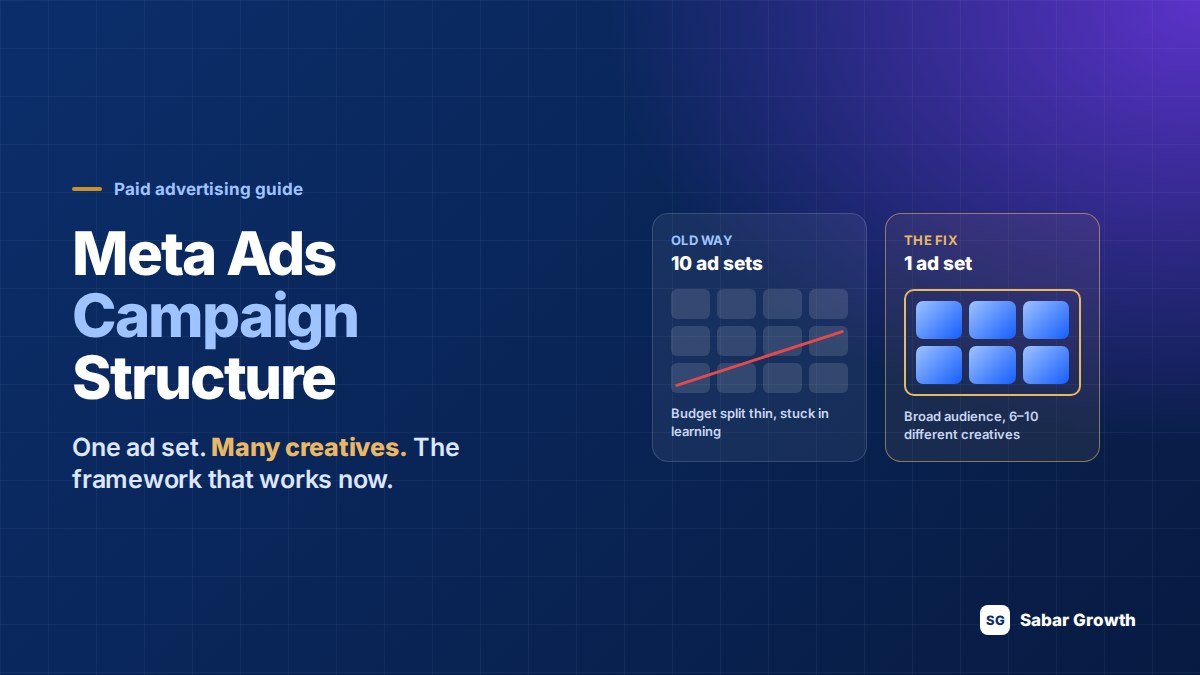

If you’ve been running Meta ads for a website business, you’ve probably been told to build it like this: one campaign, then a handful of ad sets, each one aimed at a different interest, a lookalike, a narrow demographic slice. Seven ad sets fighting for the same daily budget, each one starved of data, each one stuck in its own permanent learning phase.
That structure made sense years ago. It doesn’t anymore. Meta’s ad system in 2026 is increasingly driven by machine learning that reads creative, behavior, and conversion signals to figure out who’s likely to respond — and it does that job better when you stop trying to do it manually for it.
This isn’t about “targeting is dead” or “just go broad and hope.” It’s a specific, practical structure — audience, creative, tracking, and testing — that gives Meta what it actually needs to find your customers, without you micromanaging every variable.
Why the Old Ad-Set Structure Is Holding You Back
Most advertisers were taught to split every audience idea into its own ad set: Interest A, Interest B, a lookalike, a narrow demographic, another interest. It feels thorough. In practice, it splits your budget, splits your learning phase, and splits the data Meta needs to optimize — seven small, underfed experiments instead of one that actually has a chance to learn.
The Old Way
Seven-plus ad sets, one per interest, all competing for the same daily budget.
- Budget split thin across every ad set
- Each one stuck relearning from scratch
- No single ad set gets enough conversions to optimize
The Modern Way
One broad or Advantage+ ad set, carrying six to ten genuinely different creatives.
- One learning phase, one data pool
- A clear, strong signal for the algorithm to act on
- Budget concentrated instead of fragmented
The Philosophy: Give Meta Freedom, Not Restrictions
Meta’s ranking systems — including its newer recommendation engine, sometimes referred to as Andromeda — lean increasingly on creative quality, user behavior, and conversion data to predict who will respond to an ad. That’s genuinely powerful. It’s also not magic. It still depends entirely on what you feed it.
The advertiser’s job shifts from “manually define the audience” to “supply the system with enough quality information, the correct objective, strong creative signals, real conversion data, and enough time to learn.” The algorithm’s job is to find the patterns in that. Neither replaces the other.
In practice, that means avoiding a few habits that quietly restrict Meta for no real benefit: stacking too many detailed interests, fragmenting one audience into many small ad sets, restricting placements without a reason, and editing live campaigns every single day before they’ve had a chance to learn.
Start With the Right Objective — Not the Popular One
Don’t pick a campaign objective because it’s what everyone else uses. It should come directly from what you want the customer to actually do.
| Business Goal | Customer Action | Meta Objective |
|---|---|---|
| Get qualified leads | Fill a lead form | Leads |
| Generate website purchases | Complete checkout | Sales |
| Start WhatsApp conversations | Message the business | Engagement / Messaging |
| Drive genuine site traffic | Visit key pages | Traffic |
| Build brand awareness | See and recall the brand | Awareness |
Then optimize toward the deepest meaningful business event Meta can reliably get enough data on — not just any event you happen to be tracking.
Broad Targeting Isn’t Blind Targeting
“Broad” gets misunderstood as “target everyone and hope.” It isn’t. It means giving Meta a sufficiently large, eligible audience — Advantage+ where it fits your campaign type — and letting behavior, creative interaction, and conversion data guide who actually sees the ad. Real limits still apply: geography, age, legal requirements, and anything genuinely tied to your business.
Worth Understanding Plainly
A blindly broad audience with no creative variety and no conversion signal gives the algorithm nothing to optimize toward. A broad audience paired with strong signals is a completely different thing — and it’s what actually works.
Build a Creative Portfolio, Not One Ad
Here’s the part that matters most once your audience is broad: the creative itself becomes your targeting signal. Different people respond to different messages, and different formats — static images, carousels, short videos, testimonials, offer posters. Don’t ask one creative to do the job of five.
Each variation needs a genuinely different hook, angle, or message — not just a new background color. Five angles cover most of what a broad audience needs:
Problem
“Getting website visitors but no enquiries?” — speaks to visible pain.
Education
“Here’s why most visitors never become customers.” — builds understanding.
Solution
“How we turn visitors into qualified leads.” — shows the mechanism.
Proof
“See how this business generated…” — builds trust with results.
Offer
“Book a consultation today.” — converts the person who’s already convinced.
Placements, Pixel, Events & CAPI — Get the Foundation Right
Start with Automatic Placements and let Meta decide where the ad has the best opportunity — Feed, Stories, Reels, Explore. Restrict placements only when there’s a real reason: a technical requirement, a brand-safety concern, or a creative genuinely built for one format only.
On tracking: install the Meta Pixel, then track the events that actually reflect your customer journey — PageView, ViewContent, Lead, AddToCart, InitiateCheckout, Purchase — not every event available just because it exists. Once that foundation is solid, the Conversions API adds a server-side signal layer alongside the browser-based Pixel, implemented with proper event deduplication.
Worth Knowing
CAPI strengthens signal reliability. It doesn’t guarantee performance on its own — it works best on top of an already solid campaign and creative foundation.
The Simple Trick: Feed Meta Better Information
Instead of manually telling Meta “find women 25–35 interested in X, Y, and Z,” give it better information about the business itself: what you sell, the core customer problem, your price range, your ideal customer context, your product pages, quality creatives, the correct conversion events, and any existing customer data. Meta can’t understand a business by magic — the advertiser’s job is to provide useful signals, and the algorithm’s job is to find the patterns in them.
Better input → better opportunity for the algorithm.
A Recommended Architecture (Lead-Generation Example)
Here’s how it looks assembled, for a business running a lead-generation campaign:
- Campaign: Lead Generation
- Audience: Broad / Advantage+ where appropriate
- Ad set: Minimal fragmentation — one, not seven
- Ads: Video (problem), video (education), video (solution), static message, carousel of benefits, a testimonial, an offer
- Tracking: Pixel plus meaningful events
- Optimization target: Qualified leads
Retargeting Is a Strategy, Not a Day-One Requirement
Retargeting works — cold audience, website or content interaction, engaged users, retargeting, then a lead or purchase. But it’s built on the actual customer journey and real data, not spun up automatically for every new campaign on day one.
Useful Retargeting Pools
Once there’s real data to work with, these are usually worth building:
- Website visitors and product page viewers
- Lead-page visitors and video viewers
- Add-to-cart or initiate-checkout users
Test Creative, Not Just Audiences
Testing should happen through creative variation and a real hypothesis, not endless audience duplication.
Example hypothesis
“Problem-focused videos will generate more qualified leads than offer-focused posters.”
Cheap leads are not always good leads.
Common Mistakes to Avoid
- 10+ unnecessary ad sets splitting the same budget.
- Too many interests stacked into one audience.
- Relying on a single creative for the whole campaign.
- Restricting placements without a genuine reason.
- Editing live campaigns every single day.
- Optimizing only for cheap clicks instead of real outcomes.
- Building a retargeting campaign before there’s meaningful data.
- Judging campaign performance too quickly.
Quick Reference
| Element | Old Approach | 2026 Approach |
|---|---|---|
| Audience | 7+ narrow interest ad sets | One broad / Advantage+ ad set |
| Creative | One ad, minor variations | 6–10 genuinely different angles |
| Placements | Manually restricted | Automatic, unless there’s a real reason |
| Tracking | Every possible event | Pixel + meaningful, journey-based events |
| Retargeting | Set up from day one | Built once real data exists |
Getting Started This Week
Pick one live campaign that’s currently split across too many ad sets. Consolidate it into a single broad or Advantage+ ad set, build five real creative angles instead of one, confirm your tracking is pointed at the right event, and give it enough time to actually learn before touching it again.
Frequently Asked Questions
It depends on having the right supporting signals. A broad audience paired with strong creative variety and real conversion data consistently gives Meta’s algorithm more to work with than a narrow interest audience with a single ad and thin conversion data. Results still vary by business, budget, and market.
As few as the strategy genuinely requires — often just one. Create separate ad sets or campaigns only when there’s a real strategic difference: a different objective, a different market, or a different funnel stage, not simply because another audience idea exists.
Andromeda is part of Meta’s recommendation and ranking infrastructure, and it leans more heavily on creative, behavior, and conversion signals than older, simpler targeting logic. It doesn’t mean targeting no longer matters — it means creative quality and clean conversion data matter more than ever.
Once there’s meaningful engagement or conversion data to build from — not on day one by default. For a brand-new campaign, focus first on a solid broad or Advantage+ structure with strong creative, then layer in retargeting as real visitor and engagement data accumulates.
CAPI strengthens the reliability of the conversion signals Meta receives, especially where browser-based Pixel tracking is incomplete. It doesn’t guarantee better performance on its own — it works best implemented properly, with deduplication, on top of an already solid campaign and creative foundation.
Want This Built Into a Full Growth System?
A better campaign structure is a strong start — a full-funnel system across Meta, Google, tracking, and CRM is a different scale of setup. See how it’s worked for real clients first.
Sabar
Founder, Sabar Growth — Google Ads & Meta Ads
Founder of Sabar Growth, a founder-led performance marketing agency based in Muscat, Oman, working with businesses across Dubai, UAE, Saudi Arabia, Qatar and the GCC. Years of hands-on experience managing Google Ads and Meta Ads campaigns with direct accountability for qualified leads, cost per lead, and revenue.
45,000+ qualified leads
141× best blended ROAS