Meta Ads vs Google Ads: India vs GCC, Explained Simply
A beginner-friendly guide to how Meta Ads (Facebook & Instagram) and Google Ads behave differently in India compared to the GCC — and why the same ₹1,000 budget doesn’t work the same way in Dubai.

If you’re learning digital marketing, you’ve probably heard: “Meta Ads and Google Ads work differently in India than in the Gulf.” That’s true — but nobody explains why in simple terms. This post breaks it down so you actually understand the logic, not just memorize the difference.
The One Idea to Remember
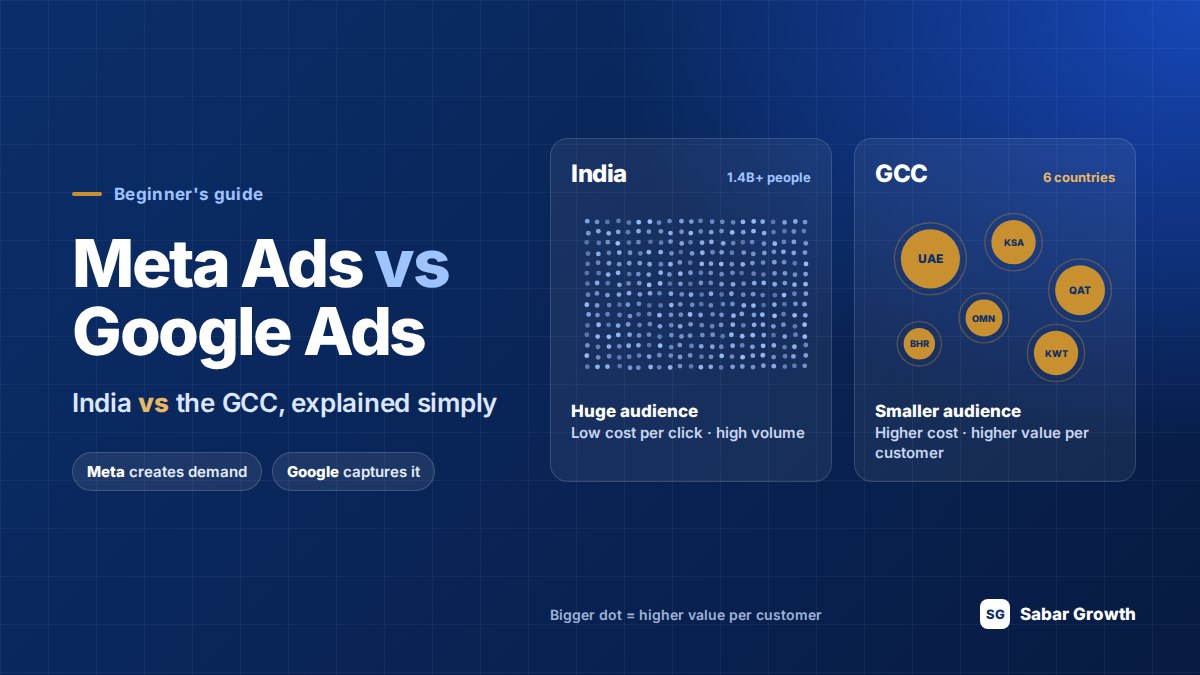
India has a huge audience at a low price. The GCC (UAE, Saudi Arabia, Oman, Qatar, Kuwait, Bahrain) has a small audience at a high price — but each person there can spend much more money. That single fact explains almost every difference in this article.
Meta Ads vs Google Ads: The Basic Difference
Before comparing countries, remember what each platform actually does:
- Meta Ads (Facebook + Instagram) shows your ad to people based on their interests — even if they weren’t looking for your product. This is called demand generation.
- Google Ads shows your ad to people who are already typing a search, like “best gym near me.” This is called demand capture.
Neither one is “better.” A smart marketer uses Meta to introduce people to a product, and Google to catch them when they’re ready to buy.
Quick Comparison: India vs GCC
| Factor | India | GCC (UAE, Saudi, etc.) |
|---|---|---|
| Population size | Very large (1.4B+) | Small (a few million per country) |
| Ad cost (CPM/CPC) | Low | 5–10× higher |
| Number of leads for same budget | High | Lower |
| Value per customer | Lower on average | Higher on average |
| Language | Many regional languages | Arabic + English (varies by country) |
| Who lives there | Mostly local population | Large expat population in most countries |
Why Does the GCC Cost So Much More?
Think of ad platforms like an auction. Every time your ad might be shown, businesses “bid” against each other for that spot. In the GCC, there are fewer people to advertise to, but many businesses — local, regional, and international — all want their attention. More businesses competing for fewer people means the price goes up.
In India, the audience is massive, so even with lots of advertisers, there’s more “room” and the price per person stays low.
The GCC Is Not “One Market” — This Is Important
A common beginner mistake is treating “GCC” like one country. It’s actually six very different countries, and even inside one country, the audience is mixed.
UAE
Mostly expats (about 9 in 10 people). English works well, but Arabic still matters for local customers.
Saudi Arabia
Largest GCC population. Arabic is the main language for most social content — English-only ads underperform here.
Qatar & Kuwait
Very high expat share, many from South Asia. Ads often need both English and Arabic.
Oman & Bahrain
Smaller, lower-cost markets — good places for beginners or small budgets to practice and test.
Common Mistake
Never copy one ad and run it unchanged across all six GCC countries — or straight from an Indian campaign. Language, culture, and buying power are different in each place, even if the distance between them is short.
Cheap Leads vs Good Leads
A lead is just someone who filled a form or clicked “interested.” A cheap lead is not the same as a good lead.
Simple Example
Imagine two leads: one costs ₹50 but never buys anything. Another costs ₹500 but becomes a paying customer. The ₹500 lead was actually cheaper in the end, because it made money. This is why marketers track more than just “cost per lead” — they track how many leads become actual sales.
Which Platform Should You Use, and When?
People are already searching for it
Use Google Ads. Example: “best dentist in Muscat.” That person is ready to act.
It’s a new or visual product
Use Meta Ads. Example: a new fashion brand nobody is searching for yet — show it in their feed instead.
It’s a bigger purchase (real estate, education, healthcare)
Use both. Meta introduces the brand, Google catches the search that follows a few days later.
You have a small budget
Pick one platform that matches your goal instead of splitting a tiny budget across both.
The goal isn’t picking Meta or Google — it’s understanding what job each one does, and matching that job to your market.
If you’re just starting out, I teach both platforms with real India and GCC campaign examples in 1:1 Meta Ads and Google Ads training for beginners, in English or Malayalam.
Frequently Asked Questions
Neither is “better” on its own — they do different jobs. Meta Ads is good at creating demand by showing your product to people who aren’t searching for it yet. Google Ads is good at capturing demand from people who are already searching. Most successful campaigns use both together.
The GCC has a much smaller population than India but much higher average income, so more advertisers compete for fewer people, which pushes up the cost per click and cost per thousand impressions (CPM). India has a huge population and lower competition per person, which keeps costs low.
It’s not recommended. Language, culture, income levels, and even which countries make up the “GCC” (UAE, Saudi Arabia, Oman, Qatar, Kuwait, Bahrain) are all different from India and from each other. Copying one campaign into a new market usually performs poorly.
No. A cheap lead that never buys anything is more expensive in the long run than a costly lead that converts into a sale. This is why marketers track cost per lead alongside qualified leads, appointments, and actual sales — not cost per lead alone.
Many beginners start with Meta Ads because the interface is simpler and creative-focused, which helps you understand audiences and targeting quickly. Google Ads is a natural next step once you understand keywords and search intent.
Key Takeaway
India = big audience, low cost, high volume. GCC = small audience, high cost, high value per customer — and never treated as one single market. Learn this one framework and the rest of digital marketing strategy for these regions starts to make sense.
Want to Learn This Step by Step?
This is one of the core ideas covered in our full training program — with real campaign examples from both India and the GCC.
Sabar
Founder, Sabar Growth — Google Ads & Meta Ads
Founder of Sabar Growth, a founder-led performance marketing agency based in Muscat, Oman, working with businesses across Dubai, the UAE, Saudi Arabia, Qatar and the GCC. Years of hands-on experience managing Google Ads and Meta Ads campaigns, and has trained 1000+ students in digital marketing.
45,000+ qualified leads
1000+ students trained