Meta Andromeda Update Explained: Should You Change Your Facebook Ads Strategy?
Everyone is talking about Andromeda. Here’s what it really is, in plain words, what I’ve seen in real client accounts, and the simple way I test before changing anything.

My view in 30 seconds
- Andromeda is a real change in how Meta picks which ads to show. But it isn’t a setting, and it isn’t a new campaign type.
- In my client accounts, I’ve seen both approaches work: broad audiences with lots of different creatives, and detailed targeting.
- What works depends on the business, the goal, the budget, the creative and the data the account already has.
- So I don’t rebuild accounts because of a trend. I test both approaches early, look at real results, and scale the winner.
Why everyone is talking about Andromeda
If you run Facebook or Instagram ads, you’ve probably heard it this year: “Targeting is dead. Go broad. Creative is the new targeting.”
Most of that comes from one thing: Meta’s Andromeda update. And because it sounds big, a lot of advertisers are rushing to rebuild their campaigns.
I understand why. But I’ve also seen people switch off campaigns that were working well, just because someone online said their setup was “old”. So let’s slow down and look at what Andromeda actually is.
What is Meta Andromeda, in simple words?
Think of a company hiring for one job and receiving millions of CVs. Before anyone does a proper interview, a first screening picks a shortlist. Only the shortlisted CVs get a real chance.
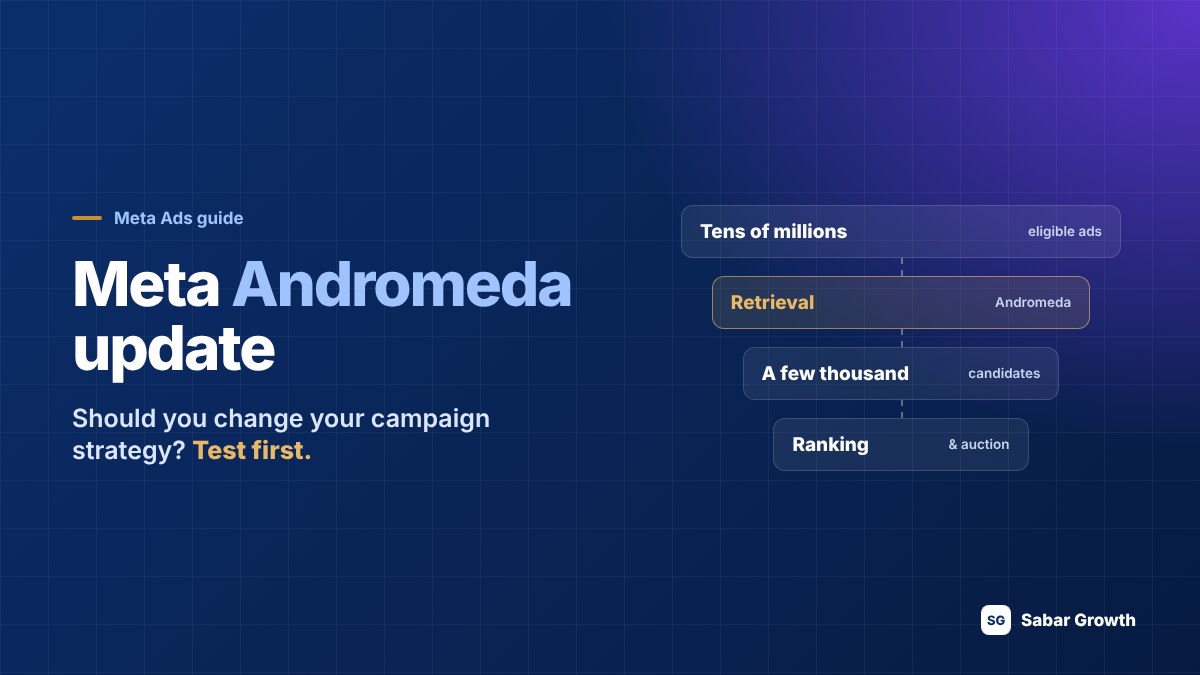
Meta has the same problem with ads. Every time someone opens Facebook or Instagram, there are tens of millions of ads that could be shown. So Meta works in stages:
Andromeda is the first screening. If your ad doesn’t make the shortlist, it never gets a chance, however good your bid or audience is.
Meta’s engineers announced it in December 2024. They built it because AI tools now let advertisers create far more ads than before, and the old shortlisting system couldn’t keep up. The new one is much smarter about matching each ad to each person.
What Andromeda is not
It isn’t a button in Ads Manager, a campaign objective or a targeting option. You can’t turn it on or off. It works quietly behind every campaign, whatever setup you use.
What Meta says vs what marketers say
A lot of confusion comes from mixing these two together.
What Meta says
- Andromeda does the first shortlisting of ads, before ranking and the auction.
- Meta now calls varied creative “the best lever to find the most relevant audiences.”
- In September 2026, Meta summed up its advice as “diversify your creative, test, and let the system optimize”.
What marketers say (not confirmed by Meta)
- Ads that look alike, or start with the same hook, get treated as almost the same ad.
- Broad audiences with different creatives usually do better.
- Fewer ad sets help Meta learn faster.
Notice that Meta’s own advice includes the word test. Nobody at Meta has said detailed targeting stopped working.
The two ways people run Meta Ads today
| Detailed targeting | Broad + creative-led | |
|---|---|---|
| Who sees the ads | You choose: interests, behaviours, lookalikes | Meta chooses, within basic limits like location and age |
| What does the work | The audience you picked | The creative: different ads attract different people |
| Setup | Several ad sets, one per audience | One or a few ad sets with many different ads |
| Often worth trying for | Niche or B2B products, small markets, new accounts | Everyday consumer products, accounts with steady sales data |
Andromeda runs underneath both. Neither one is “the Andromeda strategy”.
What I’ve seen in real client accounts
This is the part I most want you to take away.
In the accounts I manage, I’ve seen campaigns with broad audiences and lots of different creatives perform really well. I’ve also seen campaigns with detailed targeting and a more traditional setup keep bringing steady results, and sometimes beat the broad version we tested next to them.
So when people ask me “Should I switch everything to broad?”, my honest answer is: it depends on your account. In my experience, the result usually comes down to:
- Your business: how specific your customer is.
- Your goal: sales, leads or WhatsApp messages all behave differently.
- Your budget: small budgets can take a long time to learn on broad audiences.
- Your creative: how good your ads are, and how different from each other.
- Your data: how many purchases or leads the account already sends back to Meta.
For example (an illustration, not a client case): a clinic that only serves one city and a fashion brand shipping across the GCC have very different customers. It would be surprising if one campaign setup were best for both.
That’s why I don’t believe every account should jump to an “Andromeda strategy” overnight. These are my own observations from running campaigns, not a rule from Meta. If you’d like to see real accounts, I share unedited dashboards from campaigns I manage.
How I test before deciding
Instead of guessing, I let the account tell me. In the first phase of a campaign, I run both approaches side by side:
Keep what’s working
I look at current results first. A campaign that’s performing well stays on.
Build two versions
One with detailed targeting, using audiences that have worked before. One broad, with several clearly different ads: different message, format, hook or offer.
Make it a fair test
Similar budgets, the same goal and tracking that works. I give it enough time; Meta’s own guidance is roughly 50 results in a week before delivery settles.
Judge on real business results
Sales or qualified leads, cost per result, ROAS and lead quality. Not likes or clicks.
Scale the winner
Whichever approach brings steady results gets more budget. Sometimes the answer is a mix of both.
This is my own working method, not a setup Meta requires. If you want a starting point for the broad side, here’s the Meta Ads campaign structure I often begin with. And if you sell online, what happens after the click matters just as much.
Decide on
Purchases or qualified leads, cost per purchase or lead, conversion rate, ROAS, and whether the leads actually become customers.
Don’t decide on
Click-through rate on its own, CPM, or the first two or three days. Early numbers jump around a lot.
Mistakes I see advertisers make
- Rebuilding everything because of Andromeda, even campaigns that were working.
- Thinking detailed targeting is dead. It still works for many accounts.
- Thinking broad works for everyone. It doesn’t.
- Calling near-identical ads “variety”. One image with five different headlines is still one idea.
- Changing everything at once, so you can’t tell what made the difference.
- Picking a winner too early, after a few days or a handful of results.
- Ignoring lead quality. Cheap leads that never buy aren’t a win.
My final recommendation
Don’t change your whole Meta Ads strategy just because everyone is talking about Andromeda. Test what makes sense for your account, see how it responds, and find your own winning formula from real results.
The best strategy is the one that brings steady business results, not the one that follows the latest trend.
Before you rebuild anything, ask yourself one question: do I know which setup works best for my business, or am I assuming? If you’re assuming, a simple test will tell you more than any article, this one included.
If you’d like a second opinion first, I’m happy to look at your account and suggest what to test. See our Meta and Google Ads audit, or get in touch.
And if you run Meta Ads yourself and want to learn how to set up and read tests like these properly, I teach it in practical 1:1 Meta Ads coaching.
Sources
- Meta Andromeda: next-gen personalized ads retrieval engine, Engineering at Meta, December 2024
- How advertisers are adjusting to Meta’s creative diversification best practices, Marketing Brew, September 2026
- Creative diversification is the new targeting, Jon Loomer (quotes Meta’s 2025 guidance)
Frequently asked questions
Andromeda is the system Meta uses to make the first shortlist of ads for each person. From tens of millions of possible ads, it picks a few thousand, which are then scored in more detail before the auction decides what you see. Meta announced it in December 2024.
No. It isn't a button, a campaign objective or a targeting option. It works behind the scenes on every Meta campaign, whatever setup you use.
No. Meta now puts more weight on creative variety, but detailed targeting is still available and still works well for many accounts. In my experience, the only reliable way to know what works for your business is to test both.
Not all at once. Keep what's working, and test a broad version with several genuinely different ads next to it. Give both a fair budget and enough time, then put more money behind whichever brings better business results.
Ads that are genuinely different: a different message or customer problem, a different format such as video, image or carousel, a different hook in the first few seconds, or a different offer. Changing only the colour or headline of the same ad usually doesn't count.
Long enough for each version to get a meaningful number of sales or leads, usually at least a week or two. Meta's own guidance is that delivery settles after roughly 50 results in a week. Decisions based on a few days of clicks are often wrong.
Not sure which structure suits your account?
I’ll review your current Meta campaigns and tell you what’s worth testing first — and what to leave alone.
Sabar
Founder, Sabar Growth — Google Ads & Meta Ads
Founder of Sabar Growth, a founder-led performance marketing agency based in Muscat, Oman, working with businesses across Dubai, UAE, Saudi Arabia, Qatar and the GCC. Years of hands-on experience managing Meta Ads and Google Ads campaigns — and testing what actually works in each account rather than following trends.
45,000+ qualified leads
141× best blended ROAS